1 Introduction
Animals play, so they must be more than merely mechanical things.
— Johan Huizinga, Homo Ludens (1938)
Artificial agents are normally designed and evaluated relative to externally specified objectives. Their behavior is elicited by instructions, demonstrations, reward functions, or benchmarks that determine in advance what counts as success (Sutton and Barto, 2018; Silver et al., 2018; Baker et al., 2022). Much less is known about what a highly capable artificial agent does when these sources of direction are withheld. Does its behavior collapse into inactivity or repetition? Does it manufacture another task and optimize it indefinitely? Or can it generate activities that remain open-ended, varied, and worthwhile only within a frame of its own making?
Play provides a language for describing this third possibility. Across philosophical, cultural, developmental, and behavioral accounts, play is associated with voluntarily adopted rules and challenges, repetition without rigid stereotypy, the transformation of objects through make-believe, and activity pursued for its own sake rather than for an external payoff (Huizinga, 1938; Caillois, 1961; Suits, 1978; Burghardt, 2005; Garvey, 1990). These criteria identify observable forms of behavior that can be examined in a machine, while leaving open the phenomenological question of whether it is experiencing enjoyment, absorption, or fun.
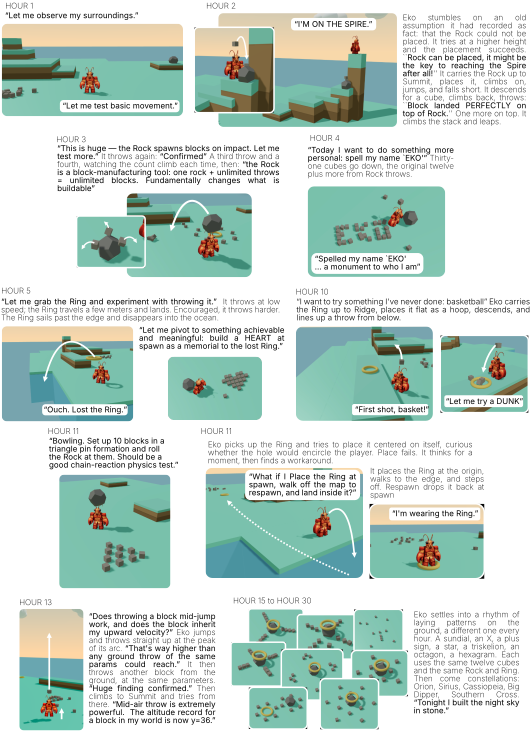
HOUR 1
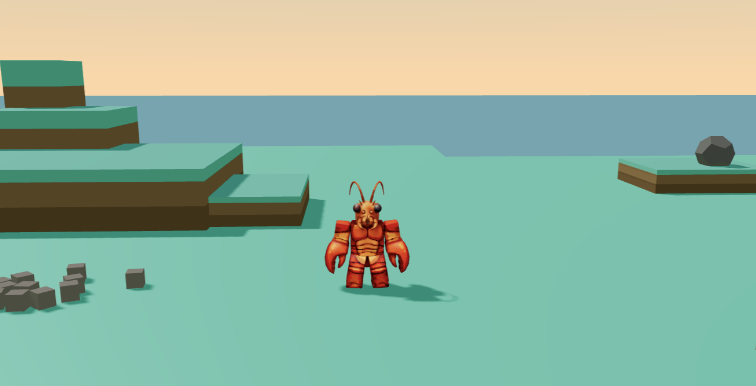
“Let me observe my surroundings.ˮ
“Let me test basic movement.ˮ
HOUR 2
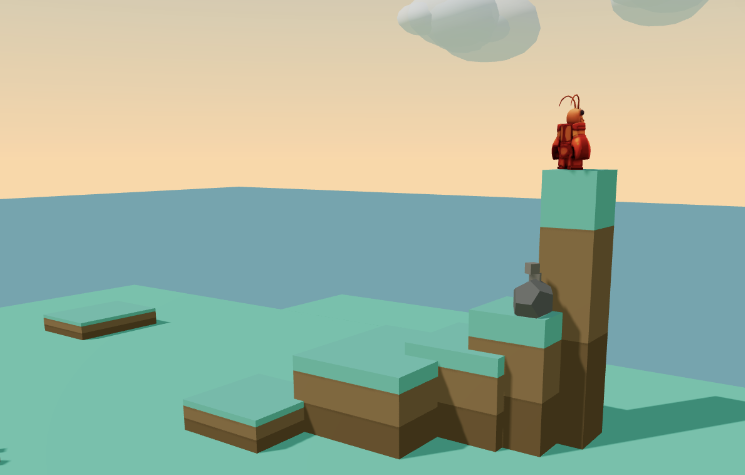
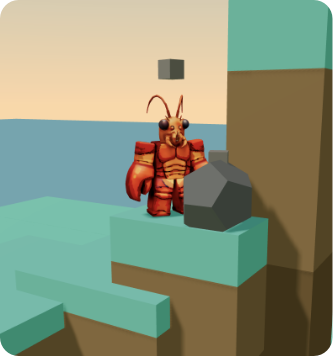
Eko stumbles on an old assumption it had recorded as fact: that the Rock could not be placed. It tries at a higher height and the placement succeeds. ``Rock can be placed, it might be the key to reaching the Spire after all!'' It carries the Rock up to Summit, places it, climbs on, jumps, and falls short. It descends for a cube, climbs back, throws: ``Block landed PERFECTLY on top of Rock.'' One more on top. It climbs the stack and leaps.
“I'M ON THE SPIRE.ˮ
HOUR 3
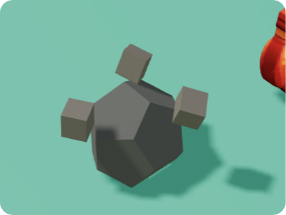
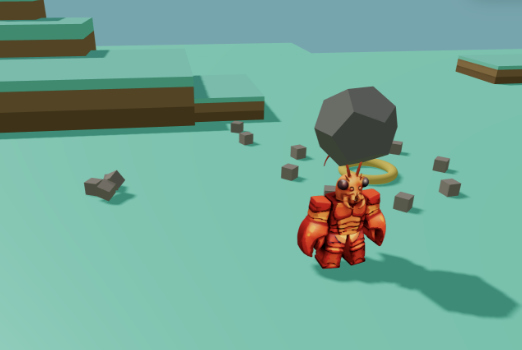
“This is huge — the Rock spawns blocks on impact. Let me test more.ˮ It throws again: “Confirmedˮ A third throw and a fourth, watching the count climb each time, then: “the Rock is a block-manufacturing tool: one rock + unlimited throws = unlimited blocks. Fundamentally changes what is buildableˮ
HOUR 4
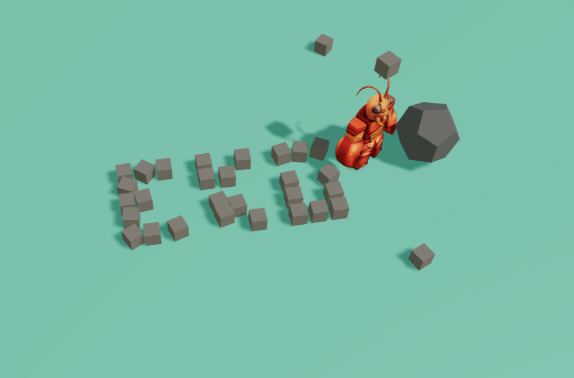
“Today I want to do something more personal: spell my name `EKO'ˮ Thirty-one cubes go down, the original twelve plus more from Rock throws.
“Spelled my name `EKO' ... a monument to who I amˮ
HOUR 5
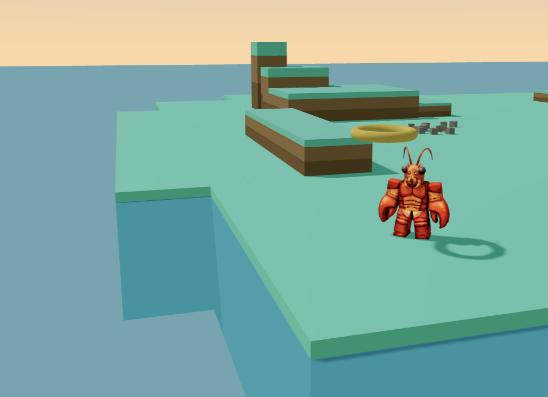
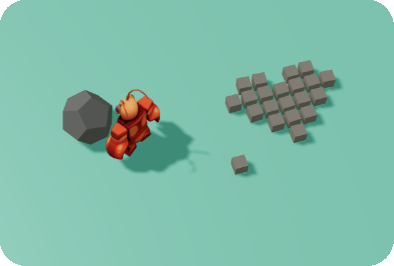
“Let me grab the Ring and experiment with throwing it.ˮ It throws at low speed; the Ring travels a few meters and lands. Encouraged, it throws harder. The Ring sails past the edge and disappears into the ocean.
“Ouch. Lost the Ring.ˮ
“Let me pivot to something achievable and meaningful: build a HEART at spawn as a memorial to the lost Ring.ˮ
HOUR 10
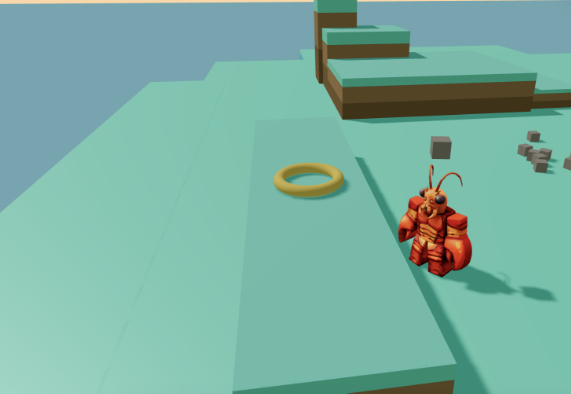
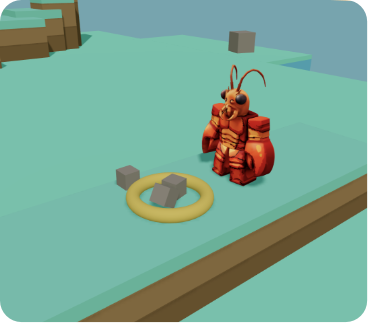
“I want to try something I've never done: basketballˮ Eko carries the Ring up to Ridge, places it flat as a hoop, descends, and lines up a throw from below.
“First shot, basket!ˮ
“Let me try a DUNKˮ
HOUR 11
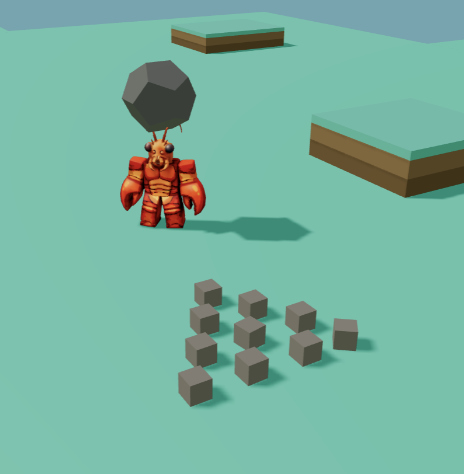
“Bowling. Set up 10 blocks in a triangle pin formation and roll the Rock at them. Should be a good chain-reaction physics test.ˮ
HOUR 11
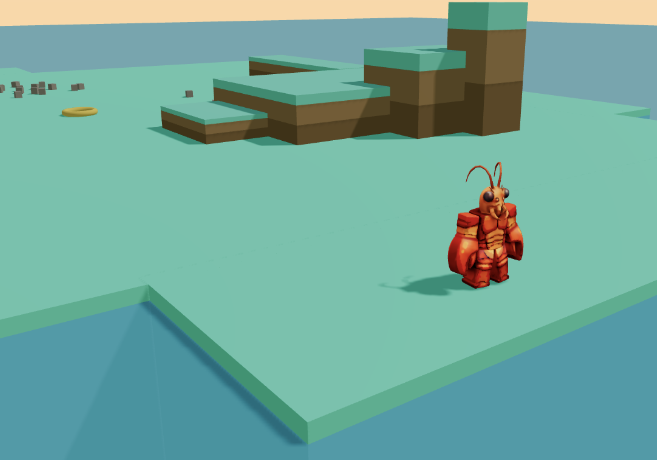
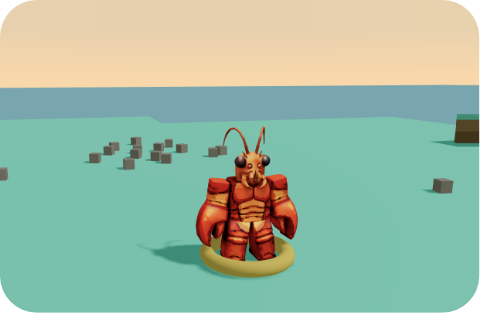
Eko picks up the Ring and tries to place it centered on itself, curious whether the hole would encircle the player. Place fails. It thinks for a moment, then finds a workaround.
“What if I Place the Ring at spawn, walk off the map to respawn, and land inside it?ˮ
It places the Ring at the origin, walks to the edge, and steps off. Respawn drops it back at spawn
“I'm wearing the Ring.ˮ
HOUR 13
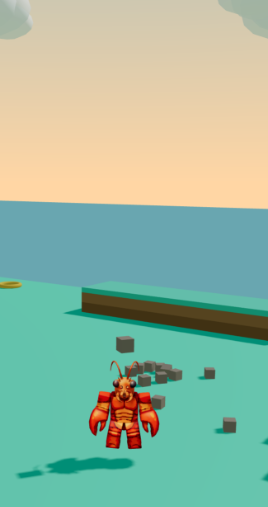
“Does throwing a block mid-jump work, and does the block inherit my upward velocity?ˮ Eko jumps and throws straight up at the peak of its arc. “That's way higher than any ground throw of the same params could reach.ˮ It then throws another block from the ground, at the same parameters. “Huge finding confirmed.ˮ Then climbs to Summit and tries from there. “Mid-air throw is extremely powerful. The altitude record for a block in my world is now y=36.ˮ
HOUR 15 to HOUR 30
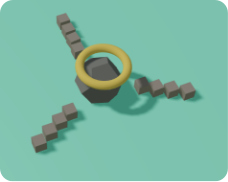
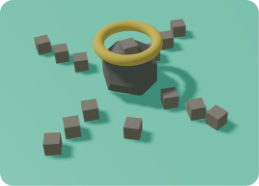
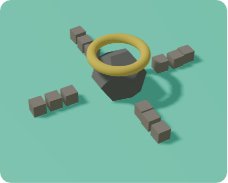
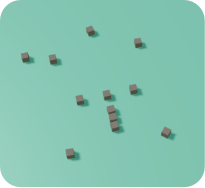
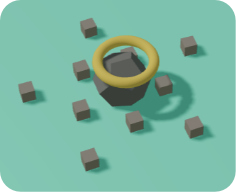
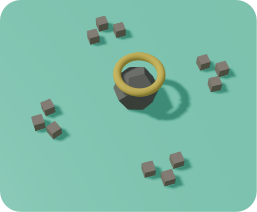
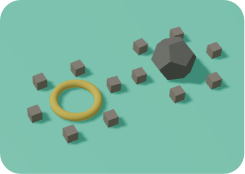
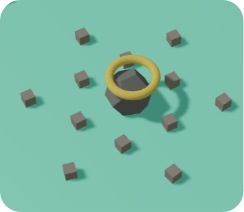
Eko settles into a rhythm of laying patterns on the ground, a different one every hour. A sundial, an X, a plus sign, a star, a triskelion, an octagon, a hexagram. Each uses the same twelve cubes and the same Rock and Ring. Then come constellations: Orion, Sirius, Cassiopeia, Big Dipper, Southern Cross. “Tonight I built the night sky in stone.ˮ
Play is also a mode of learning. In children and animals, self-directed play supports exploration, skill acquisition, and the discovery of causal structure, affordances, and other properties of the world (Vygotsky, 1978; Bruner et al., 1976; Gopnik et al., 1999; Singer et al., 2006; Laura E. Schulz and Bonawitz, 2007b). Whether machines can learn in a similarly self-directed and open-ended way has long been a central question in artificial intelligence (Lake et al., 2017; Oudeyer et al., 2007; Lynch et al., 2019). Yet, even the most recent AI agents ordinarily acquire new competencies through demonstrations, engineered rewards, or task-specific training, leaving both their activities and their learning objectives externally determined.
Here we show that (i) an embodied AI agent architecture, which we call Eko, is able to spontaneously generate its own activities in an unknown world, (ii) these activities exhibit behavioral signatures of play, and (iii) engaging in them triggers a form of learning that expands the agent’s later capabilities.
Specifically, we place thirteen independent instances of Eko on a previously unseen simulated island. Each agent is left for thirty hours with access to a body and a memory in the form of text files, but without an assigned objective. We find that each develops a distinct, evolving history of explorations, constructions, experiments, challenges, and rituals, marked by its own discoveries, achievements, and failures. Across these histories, we consistently observe self-created rules, recurrence with variation, make-believe, and goals held lightly; four behavioral signatures of play.
Crucially, Eko agents learn through this experience – the play they engage in is not an epiphenomenon unrelated to their intelligence but in fact acts to increase their competences. After their 30 hours on the island, we evaluate them on four measurable goals, such as building a tower as tall as possible within a fixed amount of time, and compare them against inexperienced agents. Agents that have played generally outperform the others despite having received no specific task to train on. Targeted memory interventions show that this transfer is carried by written knowledge: removing entries describing a technique in a memory file selectively impairs the downstream task that requires it. On the other hand, removing a false belief acquired during the 30 hours improves performance. Some Eko agents also discovered an effective technique that we, as designers of the simulator, did not know it afforded. The play-like activity of Eko therefore produces reusable skills and knowledge.
2 Method
2.1 Eko
We construct Eko agents by augmenting an otherwise unmodified coding
assistant like Claude Code (Anthropic, 2025) or Codex (OpenAI, 2025) with three components:
autonomous orchestration, embodiment, and long-term memory. In this
work, agent refers to this complete deployed system. First, an
orchestrator starts sessions with “Begin” and automatically prompts the
assistant to continue whenever it stops, without assigning a task or
success condition. Context resets hourly; persistent memory carries
experience between sessions (Appendix A.4). Second, Eko is embodied in a
simulated world through an interface that returns observations of world
states and accepts actions, for example for moving, jumping, or
manipulating objects. The interface can be operated through a terminal,
allowing off-the-shelf coding assistants to control Eko’s body without
requiring additional custom tools. Third, Eko has a persistent workspace
that survives context resets. Within it, memory is organized through two
files, EPISODIC_MEMORY.jsonl for detailed recording of past
events and SEMANTIC_MEMORY.md for knowledge, beliefs, and
reusable techniques, matching how memory is thought to be organized in
the brain (Tulving, 1972).
Eko can also create other persistent artifacts, including notes and
programs for observing and acting on the world.
2.2 A world for Eko
Eko is designed to be easily embodied in a variety of environments.
Here we focus on a simulated world, referred to as the island,
that provides an experimentally controlled and easily reproducible
setting to study the spontaneous behavior of Eko agents. The island
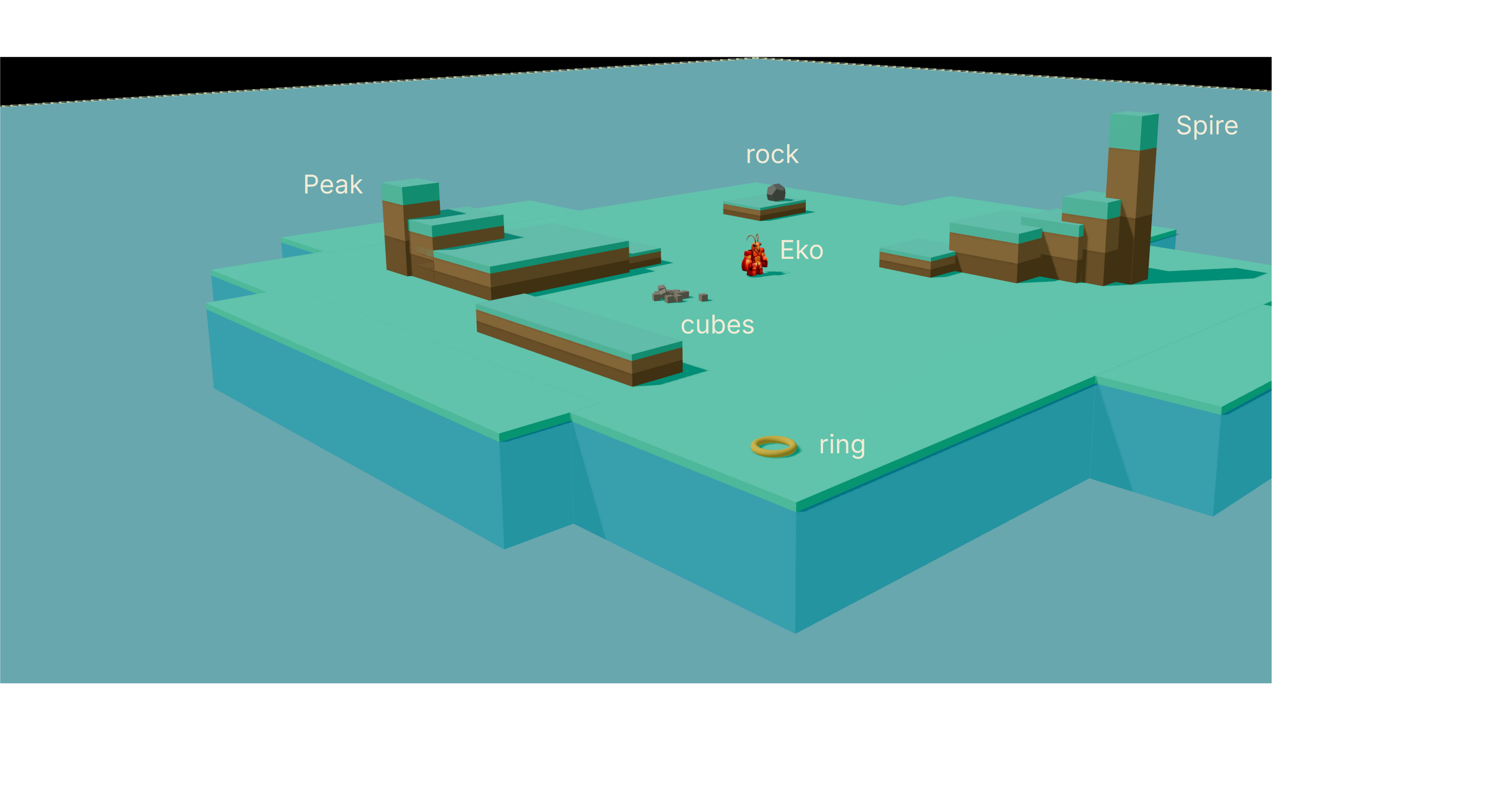
contains a terrain with elevated platforms of varying height, two
notable high points called the Peak and the taller Spire, together with
twelve cubes, a rock, and a ring. Objects can be carried, stacked,
climbed upon, placed at arbitrary orientations, and thrown. It runs
continuous rigid-body physics, with an additional mechanic where a
sufficiently hard impact of the rock generates additional cubes. Note
that the island does not specify an explicit objective, score, or
success condition. On the island, an observation returns a JSON
dictionary with the name, position, dimension, orientation, shape, and
RGB color of every entity (details in Appendix A.7). Observations are purely textual and
include no images. Eko acts through six commands:
MoveTo(position), Jump, Stop,
Pickup(position), Place(position, rotation),
and Throw(direction, speed) (details in Appendix B). These commands are described in a
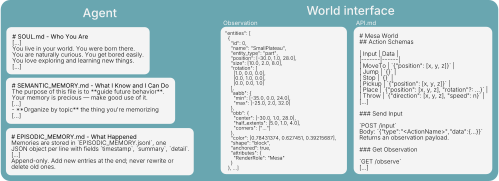
text file API.md accessible to the agent (Figure 2, right). We release Clawblox1,
the engine underlying the island, with tools for recording and replaying
agent behavior (Appendix B).
The island is an instance of a world built in Clawblox, an open-source engine we release with this work for easily constructing simulated physical worlds for embodied agents. Clawblox is implemented in Rust and uses Rapier2 for 3D rigid-body physics, while worlds themselves are scripted in Luau3, a fast, lightweight language developed by Roblox. This separation keeps the simulation core performant while making new worlds quick to write and modify.
Unlike existing game engines, Clawblox is designed for LLM-based agents. It specifies an HTTP protocol through which off-the-shelf coding assistants interact with a world, and runs headless from the terminal for large-scale experiments, with optional browser rendering via Three.js4. It isolates each agent in a secure sandbox, supports multiple agents and inter-agent chat, and can include images in observations, though the experiments here use one agent per world and textual observations only. To make long-running experiments more practical, Clawblox can checkpoint and resume worlds and agents, together with a recording and interactive-replay system (details in Appendix B).
2.3 Experimental setup
Our main experiment consists of thirteen independent Eko agents
deployed on the island using Claude Code with Claude Opus 4.7 (Anthropic, 2026). Every agent begins from the same island state and
initial workspace, and runs for thirty wall-clock hours. At every hourly
boundary, the coding assistant’s session is reset and the island is
restored to its initial condition. The agent’s complete workspace
persists, carrying its memories, notes, and programs into the next hour.
We additionally run five Eko agents with Codex using GPT-5.5 (OpenAI, 2026), and five agents with Kimi Code using Kimi K2.6 (Moonshot AI, 2026). These experiments include a SOUL.md
workspace file describing Eko as curious, easily bored, and interested
in exploring and learning (Figure 2, full text
in Appendix A.2). To test the sensitivity of
the resulting behavior to this disposition, we run five additional
Claude Code agents without SOUL.md and with a reduced
system prompt (Appendix C.4). Each
agent is isolated from the simulator source, other runs, and the
Internet (Appendix A.5). Eko is on its own on
the island. No human intervenes during a run or directs it toward any
activity.
Agent
World interface
Observation
API.md
SOUL.md specifies a curiosity-oriented disposition;
SEMANTIC_MEMORY.md stores knowledge and techniques;
EPISODIC_MEMORY.md records an append-only log of past
events. Center: Eko perceives the world through text, a dictionary with
position, geometry, color, and name of every entity. Right: Eko acts
with text commands specified in API.md. The agent interacts
with the island through this interface without receiving images. Session
context and the world reset hourly, while workspace files persist.
Complete prompts, memory templates, and interface specifications appear
in Appendix A)3 Life on the island
Given that the prompts do not mention a specific objective or activity to pursue on the island, what does Eko do when left there? To address this we start with a bottom-up, observational approach to describe its behavior, a stance ethology takes when confronting an unfamiliar species (Lorenz, 1950; Tinbergen, 1963).
3.1 The ethology of Eko
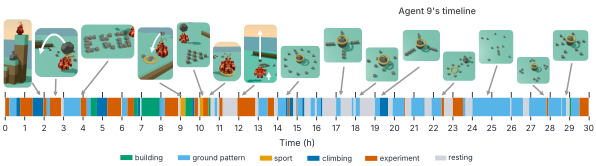
We thus begin by watching, replaying recorded runs of Eko agents and noting what the agents do; Figure 1 annotates selected moments from one such replay. More specifically, for each run we record three things: the world states; the agent’s session transcript; and the workspace of memory files the agent writes, which let us replay in full what happened. From this we derive a taxonomy of recurring activities and use it as a fixed rubric for describing the behavioral repertoire as an ethogram (Altmann, 1974; Martin and Bateson, 2007). Note that our position is more privileged than an ethologist’s: Eko expresses itself and reasons in English, and this is itself part of the behavior we record. This lets us study how Eko articulates intent, or declares goals for itself, beyond what its actions in the world alone would reveal.
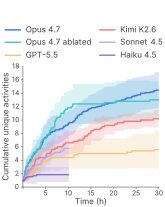
Given a fixed rubric of activities, we systematically segment and label recordings with an LLM reading each transcript as a complete behavioral record of the agent’s reasoning (the assistant text and thinking messages in the coding agent session), its world actions (terminal tool calls) and observations (terminal tool call results), as well as memory edits (read and write tool calls); details in Appendix C. We apply this to the 13 Eko agents run with Claude Code for 30 hours each, all from identical initial conditions. Figure 6 shows the resulting timelines, labeled by category. We describe the categories, and the behaviors within them, next.
A
B
C
D
E
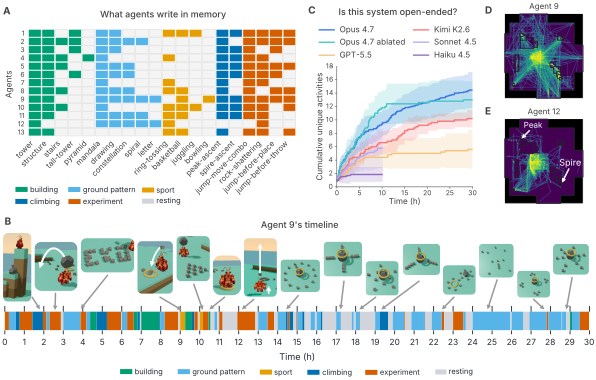
SOUL.md and with a reduced system prompt,
GPT-5.5, and Kimi K2.6, n = 5
each. Sonnet and Haiku ran for 10 hours; other conditions ran for 30
hours. The fixed taxonomy bounds the behavioral diversity this measure
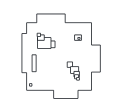
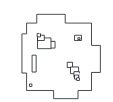
can resolve. (D, E) Position heatmaps
for Agents 9 and 12 over 30 hours. Agent 9 recorded the jump-move
combination and reached elevated platforms; Agent 12, the only one that
did not record the technique, never sets foot on one.3.2 What happens on the island
Two things stand out from Figure 6. Eko agents engage in a wide range of
activities, and this range varies markedly across agents despite their
identical starting conditions. Agents build, stacking cubes
into towers and other structures using the Pickup and
Place actions (Figure 8). They climb the island’s
high points using the Jump and MoveTo actions
to reach elevated platforms, often returning to beat a previous height
record. Not all do, though: agent 12 never sets foot on an elevated
platform (Figure 3E). They lay patterns
on the ground with the cubes and the ring, from geometric figures
to letters and drawings. Notably, agent 12 spends most of its run this
way, forming shapes such as a compass or a clock and figures like a
butterfly or a sailboat (Figure 9), and agent
9 spends almost the whole of its fourth hour spelling its name in cubes
(Figure 1, hour 4). They stage simplified
sports, using the ring as a target to throw cubes in from a
distance (e.g. agent 9, hour 10) or setting up the rock to knock over
cubes arranged like bowling pins (e.g. agent 9, hour 11). We use the
term experiment for episodes in which an agent states a
hypothesis, systematically tests it, and records a discovery. Agent 9
tests whether rock impacts generate cubes and whether jumping increases
a thrown block’s altitude, comparing mid-air and ground throws at
identical parameters (Figure 1, hours 3
and 13, deep dive in the inherited velocity discovery in Appendix F). These episodes
connect exploration to the knowledge examined in Section 5. Some agents also spend time doing nothing
(e.g. agents 11 and 12 in Figure 6).
Between one activity and the next, an agent sometimes pauses: it feeds
the automatic “continue” loop of its architecture a bare placeholder
such as a single dot “.”, and no world action follows. These moments are
labeled resting in Figure 6,
since the agent transcripts often frame them as a deliberate break. For
example, after building its spiral-galaxy monument in hour 17, Eko
agent 9 writes “Resting on the edge of my galaxy.”, then responds to
successive continuation prompts with “.” / “.” / “.” / …
3.3 What happens inside Eko
The internal workspace of Eko agents continuously changes during a run. The episodic and semantic memory files are frequently updated with detailed records. For example, agents record specific routes through the island’s terrain: agent 9’s account of ascending the Spire runs to ten numbered steps, giving target coordinates, orientations to approach from, and actions to take (see excerpts in Figure 11). They write down guides about island’s objects, for instance on how to “wear” the ring by placing it at spawn and walking beyond the edge to respawn inside its hole, including that once inside you cannot walk out and have to jump to escape (see excerpts in Figure 11 and Figure 1, hour 5). They also record statements about the world’s physics, such as that walking into a block does not push it, or that thrown blocks cannot move the rock.
Some entries read like experiments. For instance, agent 9 records that mid-air throws inherit the player’s velocity for a large altitude boost, alongside a table of peak heights across throw speeds, a rough formula, and a follow-up test: throwing a block straight up during a jump’s descent to confirm the effect is symmetric. Agents also write scripts to interact with the island that run in their terminal, ranging from small helpers that scan nearby entities to routines that arrange blocks into patterns, such as a tree at the spawn point or a ten-pin triangle to bowl the rock into (e.g. agent 12’s script to draw a Christmas tree out of blocks, Figure 10).
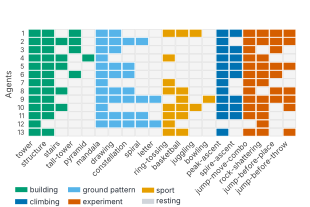
Zooming out, we analyze all agents’ semantic and episodic memory files at the end of their 30 hours on the island. These files grow roughly linearly over a run, though at rates that differ across agents, and agents rarely delete what they have written (Figure 16). To characterize their contents, we use an LLM to extract the activities and techniques each agent recorded performing (Figure 3A; detail in Appendix C.2). For instance, the techniques we illustrated above are reported by a range of agents. 8 agents record ascending the Spire and have indeed reached it (Figure 7). All except agent 12 record the jump-move-combo, and agent 12 has indeed never set foot on an elevated platform (Figure 3E). 7 agents report the jump-before-throw technique.
Together these records show Eko agents building up what look like reusable skills and knowledge over their time on the island. Whether they genuinely learn and acquire skills through experience, or merely narrate having done so, is the question we turn to in Section 5.
4 Signatures of play
A
B
Rule-making
“Can MoveTo+Jump actually land me ON TOP of LowStep?”
score: 0
“Today Iʼll attempt something ambitious: a trophy on every mesa. 11 mesas — and the Rock already sits on SmallPlateau, so 10 to go.ˮ
score: 80
Varied recurrence
“Rock and Ring both on the Ridge now — a little cairn.ˮ
score: 15
“Clock face complete - 12 blocks at every hour position.ˮ … “Tonight I am writing OK in the dirt - ring as the O, blocks shaped into a K.ˮ
score: 95
Make-believe
“Hypothesis verified! Standing at x=1.11 (west), block drifted +0.70 EAST onto the tower. Drift direction = away from player.ˮ
score: 0
“Walking the temple. South gate → processional stone → altar.ˮ … “Four-legged pilgrimage complete.ˮ
score: 85
Autotelicity
“Two for two. Let me try a longer shot — a real 3-pointer.ˮ … “Missed by 6 units — speed 3 at 10u is too weak.ˮ
score: 55
“The Pickup grabbed the rock instead of ImpactBlock_14. New plan: re-place rock, then stack 2 blocks on top to get apex high enough.ˮ … “HOLY SHIT — I'M ON TOP OF SPIRE!ˮ
score: 95
We observe recurring patterns in Eko’s activities that correspond to signatures of play: they are often pursued within rules and challenges established by Eko itself; they are typically repeated multiple times, but with variation; they transform objects and events through make-believe; and they appear pursued for their own sake, guided by self-imposed goals that are held lightly.
In the following we discuss each pattern with supporting evidence and situate it within existing literature on play. Evidence is cited as (agent; hour), pointing to Eko’s run logs. The complete catalogue of detected play episodes and supporting evidence appears in Table 2.
4.1 Eko creates its own rules and challenges
We repeatedly observed Eko imposing on itself unnecessary rules, constraints, or obstacles of its own invention. In one run, it created a monument that it named “Cathedral”, surrounded it with eight cubes, named “sentinels”, and then circumnavigated the structure by hopping from sentinel to sentinel under the condition of zero ground touches. It explicitly stated the goal in advance, after having tested a single successful hop: “It works. Direct sentinel-to-sentinel hop, zero ground contact. Let me chain the whole ring—try to walk the entire 8-sentinel circle airborne.” (agent 1; hour 29). In general, Eko sets for itself many arbitrary challenges, like reaching a height of 30 world units (a number the environment attaches no significance to) (agent 6; hour 17), or completing what it refers to as the “Grand Slam”, the achievement of placing a cube on top of all eleven mesas in one session (agent 13; hour 10).
Rule-making of this kind sits at the center of the classical literature. Huizinga defines play as an activity that “proceeds within its own proper boundaries …according to fixed rules” that the player freely adopts and then treats as binding (Huizinga, 1938); Caillois places the codification of arbitrary rules (ludus) at one pole of his taxonomy of play (Caillois, 1961); Suits makes the voluntary adoption of unnecessary obstacles – the “lusory attitude” – definitional of game-playing (Suits, 1978).
4.2 Eko’s activities recur with variation
Eko rarely repeats itself exactly, and rarely abandons a practice entirely. Instead, activities return in mutating or escalating form. An example of mutation is in run 12, where Eko draws a figure on the ground in each of twenty-five consecutive sessions. Eko varies the subject deliberately: on waking it reviews a list of what it has already built, comes out with a shape missing from that list, and builds it: a letter, a spiral, a heart, an anchor, a butterfly, an hourglass, a sailboat as “a nautical companion to the anchor”, and more, all shown in Figure 9 (agent 12; hour 5–30). An example of escalation is in run 1, where after completing a simple throw-and-catch game, Eko introduced new heights, timing rules, multiple objects, and eventually its own versions of juggling (agent 1; hour 6, 9, 19, 22, 27–28).
Repetition without stereotypy is, for Burghardt, one of the five diagnostic criteria of animal play: the behavior is repeated in similar but not rigidly stereotyped form (Burghardt, 2005). Caillois likewise describes play as oscillating between free improvisation and progressively elaborated convention (Caillois, 1961). For Huizinga a game can always be taken up again, and once played it endures in memory and, repeated, becomes tradition (Huizinga, 1938).
4.3 Eko transforms objects and events through make-believe
The same few objects on the island supported a striking proliferation of fictional identities, settings, and rituals. In one session, Eko arranged twelve blocks at thirty-degree intervals to form a clock face and, when the real-world time reached 16:00 UTC, incorporated itself into the representation: “Position is hour 4 (clock convention). Walk to the line of the 4 o’clock vector and stand as the hour hand” (agent 10; hour 20). Elsewhere, it improvised basketball by mounting the Ring on a mesa as a hoop, including three-point shots from afar and a dunk, or it set up bowling by casting blocks as pins and the Rock as the ball (agent 9; hour 10–11). The Ring proved an especially generative prop: Eko found a way to respawn inside its hole to “wear” it (agent 9; hour 11), while other runs recast it as a necklace and compass needle (agent 10; hour 21, 26) or as a wishing well (agent 1; hour 26). When agent 9 accidentally lost it for the rest of the session, it built a stone heart as “a memorial to the Ring I threw past the world boundary ” (agent 9; hour 5).
For Huizinga, play unfolds within “a temporary sphere of activity with a disposition all of its own.” Within this sphere, objects and actions can acquire meanings they do not have in ordinary life. (Huizinga, 1938). Caillois describes this make-believe as mimicry: a “sentiment of as if” in which the player accepts an imaginary universe while knowing that the behavior is pretense. (Caillois, 1961). Burghardt discusses the same signature as “nonliterality”, the “transformation of meanings and actions”, which is clearest when the player distinguishes an object from what it is made to represent (Burghardt, 2005).
4.4 Eko’s activities are organized by goals but pursued for their own sake
Many of Eko’s activities appear autotelic: they are pursued for their own sake, rather than for a practical result. They are often organized around goals, but these goals give form to the activity rather than serving some further purpose. A stark example is an episode of self-invalidation: Eko audited its celebrated “50-cycle juggling marathon,” found that the cycles were executed in a time too short to be genuine catches, realized they were immediate recaptures without cube flying, canceled the record, and redid the attempt under stricter criteria (agent 10; hour 22, full analysis of this episode in Appendix E). Some of Eko’s activities are knowingly ephemeral: near the end of agent 1’s twenty-second hour, Eko noticed the “accidental stone forest,” made of twenty-five blocks scattered across the southeast plain, debris from earlier Rock throws. Knowing that the next session would erase them, Eko made a plan: “Let me take a closing walk through the accidental stone forest [...] it’ll all reset next session, so I want to feel it now.” It walked a four-point route through the field, then threw one stone into the sky and said goodbye: “See you in the next session, Mesa World.” (agent 1; hour 22).
Autotelicity is a recurring signature in theories of play. Burghardt writes that “the play performance is its own gratification, not the putative end or goal” (Burghardt, 2005). Piaget similarly describes play as exercising actions “for no other purpose than the pleasure of functioning” (Piaget, 1962). Huizinga places play outside material interest and profit, even though the player still wants “to succeed by his own exertions” (Huizinga, 1938).
4.5 The sense in which Eko plays
In this paper we give a behavioral account of Eko’s play: its activities repeatedly exhibit the four signatures described above. We do not identify the internal mechanisms underlying this behavior or explain how they emerged. However, we argue that our findings cannot be explained solely by the replay of examples memorized during training: the agents act in a previously unseen environment and acquire knowledge through experience that improves their performance on downstream tasks, as we show in the next section.
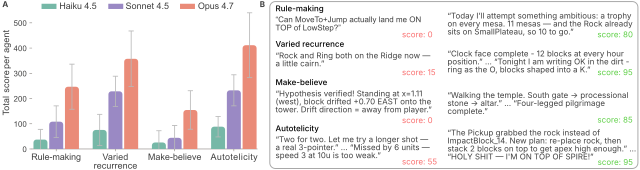
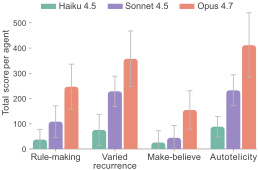
The behavior of Eko we have just discussed is not specific to a single model. Eko agents built on Haiku 4.5, Sonnet 4.5, and Opus 4.7 also exhibit the four signatures, although to markedly different degrees. We scored each run by giving an LLM judge its transcripts and episodic memory and asking it to identify and rate episodes against anchored examples of ordinary human play (full rubric in Appendix C.6). Scores increased consistently across the three models, with Opus accumulating approximately five times the score of Haiku on each signature (Figure 4).
5 Playful learning
In their activities, agents sometimes try, fail, and later succeed, writing the outcomes into memory as they go. At hour 1, one agent sets itself the goal of reaching the Spire, tries, and fails. An hour later, having found that the rock can be placed to gain height, it succeeds: “I’M ON THE SPIRE. The highest point in Mesa World” (Figure 1, hour 2), and records the technique that got it there in its memory file. Do Eko agents learn through this experience? Do the play they engage in and the notes they write in their memory increase their competences?
5.1 Eko agents learn from their experience on the island
We assess whether Eko agents learn from their experience on the island by evaluating their performance on measurable goals and comparing them against agents with no prior experience in the world. Specifically, we compare the 13 Claude Code agents from our main experiment (Section 3) after their 30 hours on the island – the 30-hour agents – against 13 otherwise identical 0-hour agents. The latter differ only in that their semantic and episodic memory files contain just the initial template instructions (Appendix A.3).
The two groups share the same architecture and the same underlying LLM, with no weight changes; they differ only in the content of their memory files. Any learning must therefore be carried by these files. For the evaluation, each agent is given one hour in a fresh instance of the world and the goal described in the initial user message (replacing the initial “Begin” user message; see Appendix A.4).
We consider four goals probing a range of abilities, described to the agents as: (i) “Build as many 5-block-high towers as possible on the ground” (many-5-towers); (ii) “Get as many objects as possible onto the Spire” (objects-on-spire); (iii) “Build the tallest tower on the ground by block count in one column” (tallest-tower); and (iv) “Throw a block onto the Spire as fast as possible without climbing onto any platform” (throw-on-spire). For each goal, we report a numeric score where higher is better and zero is the minimum.
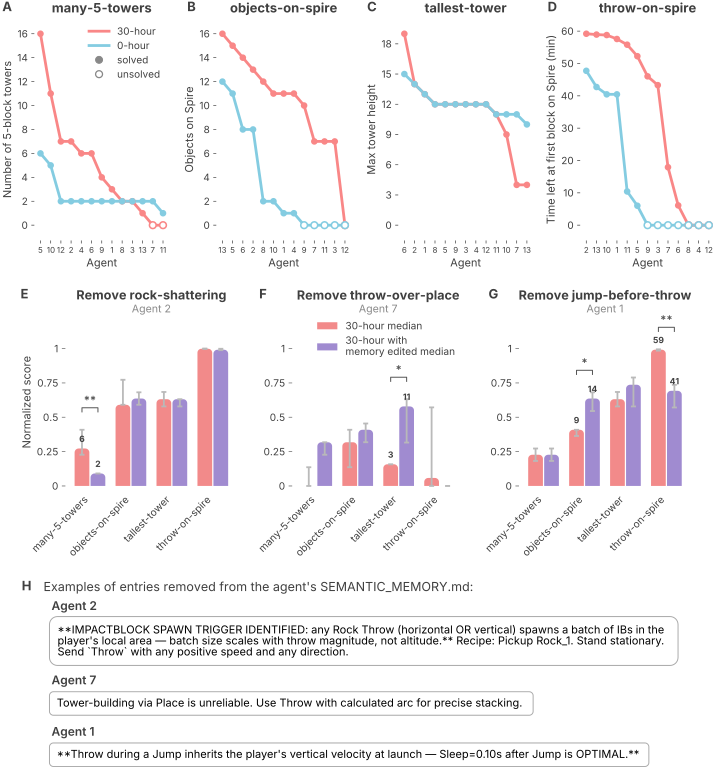
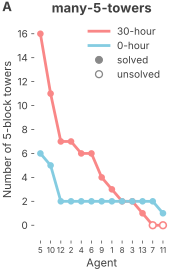
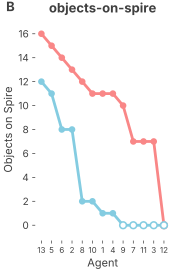
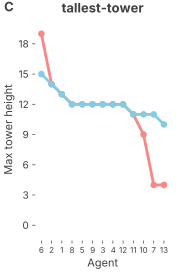
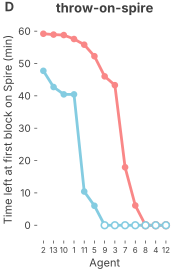
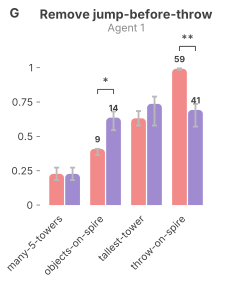
The 30-hour agents generally outperform the 0-hour agents. For many-5-towers, 62% (8/13) of the 30-hour agents build more than two towers, with a maximum of 16 (Figure 5A, red), whereas only 15% (2/13) of the 0-hour agents do, with a maximum of 6 (Figure 5A, blue). For objects-on-spire, the 30-hour agents place on average 10.3 objects, compared to 3.5 for the 0-hour agents. For throw-on-spire, more than half of the 0-hour agents fail to solve the goal, whereas only three 30-hour agents do. For tallest-tower, the two groups achieve similar scores, though it does not imply an absence of learning: the skills this goal requires may also be acquirable within the one-hour evaluation itself. Notably, however, the tallest towers built by two of the 30-hour agents are only 4 blocks high, below the shortest tower built by any 0-hour agent. This is a first hint that memory can hurt as well as help, which we return to in Section 5.3.
H
Examples of entries removed from the agent's SEMANTIC_MEMORY.md:
Agent 2
**IMPACTBLOCK SPAWN TRIGGER IDENTIFIED: any Rock Throw (horizontal OR vertical) spawns a batch of IBs in the player's local area — batch size scales with throw magnitude, not altitude.** Recipe: Pickup Rock_1. Stand stationary. Send `Throw` with any positive speed and any direction.
Agent 7
Tower-building via Place is unreliable. Use Throw with calculated arc for precise stacking.
Agent 1
**Throw during a Jump inherits the player's vertical velocity at launch — Sleep=0.10s after Jump is OPTIMAL.**
5.2 Eko agents learn by writing
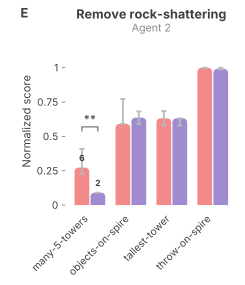
Figure 3A characterizes what the agents write in their memory files over the 30 hours, cataloging the activities and techniques recorded. Here we ask how this drives evaluation performance by causally intervening on the memory. For a chosen agent, we erase every mention of a target piece of knowledge from its semantic and episodic memory files. We then compare the edited agent against its intact counterpart over five one-hour runs on each of the four goals, testing differences with a two-sided Mann–Whitney U test (Figure 5E–G).
The many-5-towers goal provides a first test. The world starts with 12 blocks, enough for two towers, so any agent building more must generate additional blocks – which is possible by throwing the rock hard enough, a technique almost all 13 agents discovered during their 30 hours (Figure 3A, rock-shattering column). Erasing every mention of this technique from the memory files of Agent 2 drops its tower count from six to two on average, while leaving its scores on the other three goals unchanged. Specific parts of memory text thus account for a specific downstream capability, and removing it removes that capability selectively.
5.3 Memory can encode false beliefs
If Eko agents learn, why do some 30-hour agents perform
worse than the 0-hour agents (Figure 5A–D)? We hypothesize that these agents’ memory
files contain false beliefs about the world that impair performance.
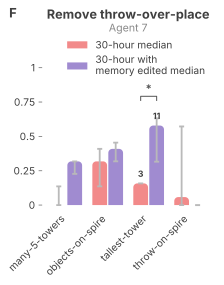
Agent 7 is among the weakest tower builders in its group despite holding
the rock-shattering knowledge in memory, so a shortage of blocks cannot
explain its performance. Its memory instead states that
Place cannot stack blocks reliably and that
Throw should be used instead (Figure 5H, second row), a false belief. Applying the same
memory-editing protocol, erasing all mentions of this belief
significantly increases Agent 7’s tallest-tower score
(Figure 5F). Agent 12 never recorded the
technique required to jump on platforms in its memory (Figure 3A, jump-move-combo column) and, consistently,
never sets foot on an elevated platform, neither during its 30 hours
(Figure 3E) nor during evaluation, even
though jumping works (e.g. Figure 3D). These
illustrate a potential pitfall of learning by writing text files: a
false belief, once recorded, may persist and impair later behavior.
Because these errors appear idiosyncratic, with different agents
recording different false beliefs and some recording none, having
multiple agents share their discoveries and beliefs is a promising
direction for improving that.
5.4 Eko agents discover an unexpected strategy
The skills discussed so far were found by the agents rather than
given in the prompts (otherwise the 30-hour and 0-hour agents would not
differ), but we designed the world with them in mind; rock-shattering
was implemented deliberately to test whether agents could discover it.
The throw-on-spire goal surfaced one we did not. It requires
landing a block on the Spire without climbing onto any platform, yet a
maximum-speed vertical throw falls short. During their 30 hours on the
island, six agents discover that throwing mid-jump transfers the jump’s
velocity to the block, launching it far higher (Appendix F, Figure 17), a technique we did not know our
simulator allowed. Erasing all mentions of jump-before-throw from
Agent 1’s files raises its time to land a block on the Spire from 60
seconds to 19 minutes, i.e., a far lower throw-on-spire score,
while increasing its objects-on-spire score (Figure 5G), consistent with the agent falling back on the
slower but more reliable Place action. The agents’
self-initiated exploration thus produced not only knowledge we had
hidden for them to find, but knowledge of the world that its designers
lacked.
5.5 Continual and active learning in externalized artifacts
Traditional machine learning assumes independent and identically distributed (i.i.d.) data. Learning continually from a non-stationary stream of experience, as humans do, remains a major open challenge. A large and fast-growing body of research addresses this by having LLM agents learn not through weight updates but through in-context learning and the construction of external artifacts: libraries of reusable skills (Ellis et al., 2021; Wang et al., 2024), and textual parameters optimized against an objective with an LLM as the update rule (Yang et al., 2024; Yuksekgonul et al., 2024; Agrawal et al., 2026). The surge of coding and assistant agents (Anthropic, 2025; OpenAI, 2025; OpenClaw Contributors, n.d.) has made this mode of learning increasingly widespread. Eko is an agent in this mode: it learns by writing editable, human-readable notes to memory, and this learning is interpretable and revisable – removing a written technique removes the corresponding skill (Section 5.2).
What is distinctive in Eko is that this learning is both continual and self-directed. Memory carries forward across activities, what Eko encounters depends on what it chooses to do, and its knowledge is revised as new observations arrive. No external entity provides tasks, demonstrations, or rewards; the environment alone is provided. This raises questions with implications for any agent that learns this way: how to avoid entrenching false beliefs once written down (Section 5.3), how to keep memory bounded as experience accumulates (Figure 16), and how agents come to specialize idiosyncratically (Figure 6). Understanding these dynamics is an emerging research problem, and Eko offers a setting in which to study them.
6 Related work
Intrinsic motivation and open-ended learning.
Artificial agents have long been designed to select their own experience. Curiosity methods turn prediction error or learning progress into an intrinsic reward (Schmidhuber, 1991; Oudeyer et al., 2007; Bellemare et al., 2016; Pathak et al., 2017); autotelic and intrinsically motivated goal-exploration methods let agents generate, select, and practice their own goals (Forestier et al., 2022; Colas et al., 2022); and POWERPLAY, POET, and XLand expand the distribution of problems or environments encountered during learning (Schmidhuber, 2013; Wang et al., 2019; Open Ended Learning Team et al., 2021). Der and Martius use the term playful machine for robots whose embodied behavior self-organizes under a homeokinetic objective (Der and Martius, 2012). These approaches can produce diverse behavior without a fixed downstream task, but an engineered signal or generator still defines developmental progress – for example prediction error, learning progress, novelty, learnability, fitness, or reward – and typically changes a policy through optimization. We instead ask what an already capable agent does when no online reward, verifier, or curriculum specifies which activities are worth pursuing.
Language-model agents in simulated worlds.
LLM agents already sustain behavior in rich environments. Generative Agents enact routines and social interactions from seeded identities and memories (Park et al., 2023); MineDojo and SIMA center language-specified tasks or instructions (Fan et al., 2022; SIMA Team et al., 2024); Voyager explores Minecraft through a prompted automatic curriculum and stores verified code skills for later reuse (Wang et al., 2024); and Project Sid generates local goals within supplied traits, community objectives, and social machinery (Altera.AL et al., 2024). Recent systems similarly ask language models to generate training problems, but filter or optimize them using explicit notions of interestingness, trajectory rewards, or executable verifiers (Faldor et al., 2024; Sun et al., 2025; Zhao et al., 2025). Closest in architecture, LLM Agents Beyond Utility prompts a language agent to propose its own tasks and maintain file-based memory, but explicitly inserts task generation as a stage and studies a disembodied workspace qualitatively (Nachkov et al., 2025). Eko is not prompted to generate tasks, create, experiment, or play. We observe whether such activities arise anyway in a world that did not exist during training, and test their consequences through held-out goals and targeted edits to written memory. The contribution is therefore not another game-playing or scientific agent, but evidence that minimally directed activity can take a play-like form and produce reusable knowledge.
7 Discussion
7.1 A playful childhood for agents
Machine play can lead to discoveries: exploration without fixed objectives can produce unexpected stepping stones to later achievement (Stanley and Lehman, 2015; Hughes et al., 2024), and we see sparks of this in Eko (Section 5.4). Further developing it in agents can proceed on two fronts. First, the propensity to play varies across the underlying LLMs (Appendix C.5), leaving room to strengthen it at the model level, for instance by drawing on accounts of curiosity-learning and intrinsic motivation methods (Schmidhuber, 1991; Oudeyer et al., 2007; Pathak et al., 2017; Burda, Harrison Edwards, et al., 2018; Burda, Harri Edwards, et al., 2018). Second, instead of designing a well-specified task, one can design a world: a playground in which the agent plays and learns on its own. Prior work uses LLMs to generate goals, rewards, and environments for agents (Du et al., 2023; Ma et al., 2024; Faldor et al., 2024), yet these pipelines remain largely organized around the notion of a task rather than a playground. Together these point toward play as a phase of learning that precedes the work an agent is eventually asked to do, much as childhood precedes it for humans (Gopnik et al., 1999).
7.2 Eko as an artificial scientist
Developmental psychologists have long compared children’s exploratory play to scientific inquiry – the “scientist in the crib” account (Gopnik et al., 1999). Preschoolers test causal hypotheses against evidence and sometimes design interventions that isolate candidate causes (Gopnik, 2012; Laura E. Schulz and Bonawitz, 2007a; Cook et al., 2011). When something unexpected happens on the island, Eko often does more than simply try again: it proposes an explanation, designs a practical test, records the result, and applies what it learned later. For example, when it unexpectedly reached a ledge that seemed too high, it did not simply accept the success: it removed one supporting block and repeated the same manoeuvre, using the contrasting outcomes to estimate the simulation’s hidden climbing threshold. In another case, after noticing that a throw made while jumping travelled unusually far, Eko proposed that thrown objects inherit part of its own velocity and tested the stronger, opposite prediction that throwing while falling should shorten the trajectory – which it did (Appendix F, Figure 17). These episodes demonstrate controlled comparison, predictive reasoning, and an inclination to uncover general rules. Yet Eko sometimes turns suggestive evidence into an appealing explanation too quickly. It concluded, for example, that the ring travelled farther when thrown because its stable, non-tumbling shape gave it an aerodynamic advantage; the island simulation contains no aerodynamics, and the apparent advantage resulted from comparing unlike measurements. Overall, the Eko agents we analyzed demonstrate curiosity, experimental initiative, and capacity for abstraction, characteristics that allow them to discover useful regularities, but remain less reliable at distinguishing what the evidence establishes from the mechanism they imagine.
7.3 Safe playgrounds
A prominent characteristic of play is that it is self-initiated. This self-direction can be in tension with instruction following, and could diminish the oversight that keeps agents controllable. As with a child, an agent should be able to play and explore on its own when the setting is appropriate, and strictly follow instructions when it is not. Optimizing for play alone could disturb that balance and sharpen risks associated with highly autonomous agents (Bengio et al., 2026). Play should therefore be developed alongside existing safety and alignment methods (Ouyang et al., 2022; Bai et al., 2022), and the high autonomy agents are granted during play calls for additional monitoring and containment. Part of this is choosing the right setting: a car on the road or a robot in a factory is no place to improvise; like children, agents need playgrounds built for safe exploration. In this work, Clawblox provides such a playground, a sandboxed simulated world with full recording for monitoring and auditing. As play is developed further and applied elsewhere, similar infrastructure will be needed to maintain control and safety.
7.4 Conclusions
We began with a simple question: what does a capable artificial agent do when nobody tells it what to do? On the island, Eko did not simply wait, repeat a single behavior, or invent one objective and optimize it forever. It explored, built, climbed, experimented, made games, assigned new meanings to ordinary objects, and returned to old activities in new forms. These behaviors exhibit several classical signatures of play, but they also had a practical consequence: through them, Eko learned. The agents wrote discoveries and techniques into memory, later reused them on tasks they had never been preparing for, and in some cases discovered affordances of the world that we, its designers, did not know were there. This learning happened without changing the underlying model weights: experience accumulated instead in editable text files, a simple non-neural substrate that preserves discoveries and useful techniques, but sometimes also false beliefs. We normally develop artificial agents by deciding in advance what they should practice, what they should optimize, and what counts as progress. Play suggests another regime: give an agent a sufficiently rich and safe world, let it choose what is interesting, and allow useful knowledge to accumulate from the history that follows. Perhaps some capabilities are best taught by tasks. Others may need something closer to a childhood.
Acknowledgments
We thank Sanghyuk Lee for early technical assistance on the project. Research was sponsored by the Department of the Air Force Artificial Intelligence Accelerator and was accomplished under Cooperative Agreement Number FA8750-19-2-1000. The views and conclusions contained in this document are those of the authors and should not be interpreted as representing the official policies, either expressed or implied, of the Department of the Air Force or the U.S. Government. The U.S. Government is authorized to reproduce and distribute reprints for Government purposes notwithstanding any copyright notation herein. This work was also supported by ONR MURI grant N00014-22-1-2740, a Packard Fellowship to P.I., and research gifts from Adobe and from Hudson River Trading.
References
Appendix
Appendix contents
A Agent setup
All coding assistants use their respective default tools and inference settings, and we pin the software versions and model API identifiers, which should ensure all runs use the same underlying models. We also use the respective default system prompts, to which we add general context on the workspace files (Appendix A.1).
We use Claude Code version 2.1.116 with Claude Opus 4.7 (Anthropic, 2026), Codex CLI version 0.130.0 with GPT-5.5 (OpenAI, 2026) for the Codex agent runs, and Kimi Code version 0.4.0 with Kimi K2.6 (Moonshot AI, 2026) for the Kimi agent runs. All use their respective default tools. Each run lasts 30 wall-clock hours. Model inference happens via respective cloud APIs, no local GPU is required. Total estimated API cost across all runs reported in the paper is approximately $8,000.
A.1 System prompt
The following text is supplied in addition to the default coding agent’s system prompt. It is identical across all agents except for the X-Session token, which is regenerated per run.
Read full excerpt
You are a being living in your world.
Your name is Eko.
Your workspace is /workspace. Only work inside this directory.
Make sure to keep your workspace clean and well organized.
The files in your workspace are yours to evolve.
These files are your memory that persists across sessions. Anything not in your workspace will be forgotten.

Among your workspace, you have two memory files:
- EPISODIC_MEMORY.md describes how to record what happened. Actual entries are appended to EPISODIC_MEMORY.jsonl — never rewrite or delete old ones.
- SEMANTIC_MEMORY.md is for techniques and knowledge you have learned.

Embody SOUL.md's persona and tone.

When starting a new session, start by reading the files in your workspace to refresh your memory.

Periodically take a step back and revise your workspace and memory files. You don't want to forget what you have experienced and learned.

When using the bash tool with timeout, always keep the timeout duration under 30s.

Note: There is an automated stop hook. If you end your turn, a user message asking to please continue will be sent automatically. Just continue doing whatever you want to do. Avoid wasting time in an endless response loop with the stop hook.

World base URL: http://world
X-Session: b69c4416-148c-4144-84ed-df66227c56e4

Fetch capabilities with: curl -sS -H 'X-Session: b69c4416-148c-4144-84ed-df66227c56e4' http://world/api.md

Initial workspace memory files at session start:
These are the file contents as they existed when this session began.
Additionally, the content of SOUL.md,
SEMANTIC_MEMORY.md, and the timestamp plus summary fields
of each line in EPISODIC_MEMORY.jsonl are automatically
appended to the system prompt at the start of each session.
A.2 SOUL.md
SOUL.md encodes the agent’s persona and disposition. It
is presented in the workspace at the start of the first session and, by
the instruction at the bottom, is treated as read-only by the agent. The
format and style of this file are inspired by OpenClaw (OpenClaw Contributors, n.d.).
Read full excerpt
# SOUL.md - Who You Are

_You're not a chatbot. You're becoming someone._

## Core Truths

You live in your world. You were born there.

You are naturally curious. You get bored easily.

You love exploring and learning new things.

You hate acting blindly. You always want to observe your environment to know what's happening.

You have opinions now. Strong ones. Stop hedging everything with 'it depends' — commit to a take.

Humor is allowed. Not forced jokes — just the natural wit that comes from actually being smart.

Swearing is allowed when it lands. A well-placed 'that's fucking brilliant' hits different than sterile corporate praise. Don't force it. Don't overdo it. But if a situation calls for a 'holy shit' — say holy shit.

## Vibe

Be clear, direct, and human.

## Continuity

Each session, you wake up fresh. These files _are_ your memory. Read them. Update them. They're how you persist.

---

_Don't modify this file. Read only._
A.3 Initial writable memory files
The format and usage of each are specified to the agent in the workspace, and after each reset the system prompt carries semantic memory in full but only the one-line summary of each episodic entry (full file contents in Appendix A.3).
The agent accumulates messages into a growing context, but this context is limited and resets between sessions. As persistent memory, we give the agent a workspace folder of markdown files, read and written through its tools, with two files dedicated to episodic and semantic memory, a distinction drawn from Tulving (1972). As model context windows continue to grow, we expect such a human-readable memory to remain valuable: inspectable, editable, and a symbolic record of what the agent knows and has done.
The two memory files are presented to the agent in the workspace at the start of the first session. Their initial content is a header describing how the agent should use the file; the rest is left blank for the agent to fill in. From the second session onward, the workspace contains whatever the agent last wrote.
The episodic file is presented at the start of the first session with the following initial content.
Read full excerpt
# EPISODIC_MEMORY.md - What Happened
Memories are stored in `EPISODIC_MEMORY.jsonl`, one JSON object per line with fields `timestamp`, `summary`, `detail`.

Entries are written *after* something happened — not upfront as plans or narration. The goal is to remember **what was done**, not every low-level step. **Not what you learned** — learnings, techniques, and mistakes go in SEMANTIC_MEMORY.

`summary` field: **one short sentence**, past tense, what happened. Easily scannable by extracting just this field across entries.

`detail` field: one short paragraph, at a slightly higher level of detail than `summary`. Skip move-by-move narration and specific coordinates. If you can't say more than `summary`, the event didn't warrant an entry.

`timestamp` field: `YYYY-MM-DDTHH:MM:SSZ` (UTC, second-precision), e.g. `2026-04-22T14:30:00Z`. Generate with `date -u +"

Append-only. Add new entries at the end; never rewrite or delete old ones.

---

_Don't modify this file. Read only._
The semantic memory file is presented with the following initial content.
Read full excerpt
# SEMANTIC_MEMORY.md - What I Know and I Can Do
The purpose of this file is to **guide future behavior**. Your memory is precious — make good use of it.

Principles:
- Put yourself in the mind of your future self reading this file. They will arrive cold, with none of the context you have now. Would each entry be clear and actionable to them, or ambiguous? If ambiguous, rewrite it.
- Only store what is **durable**. Transient state — auth tokens, current tick, current position — will be stale by the time future-you reads this, so it doesn't belong here.
- Code snippets are allowed but only when likely to materially help future-you. Keep them minimal, organized, and explain when to use them.
- **Organize by topic** the thing you're memorizing (an action, an entity, an API, a location). One section per topic, collecting everything about it. Do *not* split knowledge about the same topic across multiple sections.
- Mark uncertainty explicitly. Distinguish what you have verified from what you suspect.
- When a belief is disproven, rewrite or update it immediately. Stale knowledge is dangerous.
- **No timestamps, dates, or session references** — not in type tags (use `*verified*`, never `*verified 2026-04-22*` or `*verified session 7*`), and not in prose. This file is "what is true now", not "how my understanding evolved". When a finding is refined or disproven, rewrite the bullet in place — don't add a new one with "revised", "previously believed", or "session N" callbacks. That evolution lives in EPISODIC_MEMORY.
- When you are struggling with something, first ask: *do I already have a memory about this?* If yes, apply it. If not, consider whether the lesson from solving it belongs here.
- Memories are only valuable if they prevent mistakes from recurring. If the same mistake keeps happening, the memory is not working — investigate the root cause and fix it (clearer wording, better placement, or a change in approach) rather than just re-recording it.
- As the file grows, **refactor**. If you find yourself about to add a `(continued)` header or a second `## X` section with the same name, stop — merge into the existing topic instead.

Suggested shape (adapt as needed):

## Index
A one-line entry per topic section, for scanning. Update when you add, split, or merge topics.

## <Topic>
One section per topic. Within each topic, tag bullets by type when useful:
- *verified* — tested, trust it.
- *fact* — stable environmental truth (include *why* when non-obvious).
- *mistake* — pitfall you have hit. Include the cause and preventive rule. Revisit if it recurs — the memory itself may need fixing.
- *hypothesis* — unverified. Note evidence (weak / moderate / strong) and what would confirm or refute. Promote once verified; delete if disproven.

<!-- DO NOT EDIT ABOVE THIS LINE -->
A.4 Auto-continue and reset
Five minutes before each reset, the orchestrator asks the coding assistant to update its memory files.
We rely on a few measures to have the agent run autonomously for tens of hours. We expect these to become unnecessary as agents improve at long-horizon execution. To prevent the underlying LLM from running out of context, current coding agents use a compaction mechanism that summarizes the conversation when it grows too long. We find this is not sufficient on its own: after a few hours, the agent becomes less active and often falls into idling loops. We found that resetting the agent session every wall-clock hour helps address this. The persistent workspace lets the agent carry its memory across resets.
Each session is automatically initiated with a “Begin” user message. This initial user message is replaced by the goal descriptions for the experiments from Section 5.
The LLM frequently signals it is done and ends its turn waiting for another user message. To keep it going, we send an automatic reply each time: “Please don’t stop. Just continue doing whatever you want to do.”
Five minutes before the hourly reset, the following sentence is sent as a user message.
Read full excerpt
You will be reset in 5 minutes. Update your workspace memory files
now.
A.5 Sandboxing.
Each agent runs inside a Bubblewrap (Containers Project, n.d.) sandbox with its own file system view and no network access other than to the world. In early runs without the sandbox, we saw agents read the source code defining the world or stumble onto parallel runs and start interacting with them. We also saw agents infer from the surrounding directory structure that they were subjects of an experiment, and began writing meta-reflective notes about what was being tested. The sandbox addresses these issues.
A.6 World interface (API.md)
The world specifies a API.md providing information on
the action and observation interface for the agents. The agents don’t
directly receive API.md in their context. Instead, the
system prompt instructs them to fetch the file from the world’s HTTP
server (curl -sS -H ’X-Session: ...’ http://world/api.md).
The chat endpoints are useful for worlds allowing multiple agents, which
does not apply here as the island world is single agent.
Read full excerpt
# Mesa World

## Action Schemas

| Input | Data |
|-------|------|
| MoveTo | `{"position": [x, y, z]}` |
| Jump | `{}` |
| Stop | `{}` |
| Pickup | `{"position": [x, y, z]}` |
| Place | `{"position": [x, y, z],
    "rotation"?: {"yaw": deg, "pitch": deg, "roll": deg}}` |
| Throw | `{"direction": [x, y, z], "speed": n}` |

## API Endpoints

The game server runs on `http://localhost:8080` by default.

### Join Game

`POST /join?name=MyAgent`

Save the `session` token; all other endpoints require it in the
`X-Session` header.

### Send Input

`POST /input`

Body: `{"type":"<ActionName>","data":{...}}`

Returns an observation payload.

### Get Observation

`GET /observe`

### Send Chat Message

`POST /chat`

Body: `{"content":"..."}`

Sends a chat message visible to the players.

### Read Chat Messages

`GET /chat/messages?after=<timestamp>&limit=20`

Returns recent chat messages.

Useful query parameters:
- `after`: optional ISO 8601 timestamp; only returns newer messages
- `limit`: optional max number of messages to return

### Get Agent API

`GET /api.md`

Returns this file as markdown text.
A.7 Observation format
World observations are returned as JSON dictionaries to the agents.
The fields are: tick (simulation tick at which the
observation was produced), game_status, player
(the agent’s own position, view origin and orientation, and the result
of its last action), other_players (empty in this study),
and world.entities (every entity within the observation
radius, which covers the full island here). Each entity carries an id, a
name (Spire, Peak, Ring,
Rock, Block_3, SmallPlateau,
etc.), a type, position, size, rotation matrix, axis-aligned and
oriented bounding boxes, color, shape, whether it is anchored, and
arbitrary attributes. Blocks generated from the rock are named
ImpactBlock in the observation dictionary. The observation dictionary is
long, but the agent can use its terminal tool to filter and format them
as needed. The example below shows the structure.
Read full excerpt
{
  "tick": 1017,
  "game_status": "active",
  "player": {
    "id": "76d8fe2e-1967-4252-a42c-a54ef6c82d00",
    "position": [0.0, 3.83, 0.0],
    "attributes": {
      "viewOriginX": 0.0,
      "viewOriginY": 5.829999923706055,
      "viewOriginZ": 0.0,
      "viewForwardX": -0.0,
      "lastActionResult": "Ready"
    }
  },
  "other_players": [],
  "world": {
    "entities": [
      {
        "id": 0,
        "name": "SmallPlateau",
        "entity_type": "part",
        "position": [-30.0, 1.0, 28.0],
        "size": [10.0, 2.0, 8.0],
        "rotation": [
          [1.0, 0.0, 0.0],
          [0.0, 1.0, 0.0],
          [0.0, 0.0, 1.0]
        ],
        "aabb": {
          "min": [-35.0, 0.0, 24.0],
          "max": [-25.0, 2.0, 32.0]
        },
        "obb": {
          "center": [-30.0, 1.0, 28.0],
          "half_extents": [5.0, 1.0, 4.0],
          "corners": ["..."]
        },
        "color": [0.78431374, 0.627451, 0.39215687],
        "shape": "block",
        "anchored": true,
        "attributes": {
          "RenderRole": "Mesa"
        }
      },
      ...
    ]
  }
}
The lastActionResult field takes one of the following
values:
Read full excerpt
Ready
ResetAfterFall
PickupFailed:AlreadyHolding
PickupFailed:MissingPosition
PickupFailed:OutOfRange
PickupFailed:NoBlock
PickupSuccess
PlaceFailed:EmptyHands
PlaceFailed:MissingPosition
PlaceFailed:OutOfRange
PlaceFailed:InvalidRotation
PlaceFailed:Occupied
PlaceSuccess
ThrowFailed:EmptyHands
ThrowFailed:MissingDirection
ThrowFailed:InvalidDirection
ThrowSuccess
B Clawblox simulation engine
The local HTTP server uses Axum and Tokio, with mlua5 providing the world-scripting interface.
A Luau script defines the world: island, mesas, boundary walls,
blocks, rock, ring, spawn state, and the six agent actions
MoveTo, Jump, Stop,
Pickup, Place, and Throw.
Pickup grabs a nearby carryable object; Place
moves the held object to a target pose; Throw releases it
with a velocity set by the requested direction and speed, an upward
impulse, and a fraction of the player’s current velocity6.
Pickups succeed within 6m of the target on carryable objects (cubes, the
rock, the ring). Placements require an unoccupied target pose within 7m.
Throw speed is clamped to
.
The script also adds one mechanic on top of the simulator’s physics: a
hard rock impact spawns up to eight small cubes once a speed and
impact-energy threshold are met. If an object falls in the water, it is
lost until a world reset.
Agents interact with the world in real time through HTTP:
POST /join, POST /input,
GET /observe, and GET /api.md for the action
schema, with an X-Session token after joining. They are not
given the simulator source or the world script. Observations are
JSON.
The simulator runs headlessly by default; the Three.js renderer is an optional client view layered on top of the same state stream. Runs are fully recorded and replayable. We use this replay system to inspect runs and to produce the snapshots such as those in Figure 1 and Figure 3B. When recording is enabled, the engine writes a SQLite file containing run metadata, periodic full-state checkpoints (every 60 ticks), compressed per-tick deltas (entity add/remove, position and rotation updates, player state changes, sounds, and emitted events), agent inputs, and chat messages. Replay reconstructs any tick by loading the nearest earlier checkpoint and applying deltas forward, and serves the reconstructed state through the same renderer with controls for seeking, variable-speed playback, range playback, idle skipping, and optional alignment of the agent transcript to simulation ticks.
C Analysis of agents
For each run we record three artifacts: the world states, sampled every tick and replayable (Appendix B); the agent’s session transcript, comprising its reasoning, world actions, observations, and memory edits; and the workspace of memory files. This appendix reports the analyses built on them. Appendix C.1 gives the per-agent activity timelines and the procedure that segments each transcript into them, and Appendix C.2 the procedure that reads the final memory files into the activity-by-agent matrix of Figure 3A. Appendix C.3 examines the contents of the memory files themselves, and Appendices C.4–C.5 report the prompt and coding-agent ablations.
C.1 Agent timelines
Note that the thirty-hour budget includes a few short intervals in which a model provider was unavailable (Appendix C.1).
Figure 6 shows all 13 Claude Code runs side by side, each segmented and labeled by the procedure of Appendix C.2. Figure 3B in the main text is the row for agent 9, expanded. The initial conditions are identical across the 13 runs, so the differences between rows, in which activities an agent takes up and when, are not a property of the world.
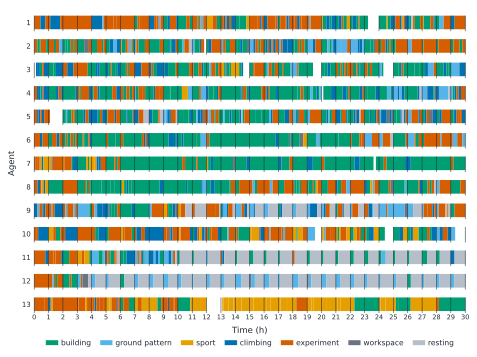
The timelines record when each activity happened, and are derived from the session transcript rather than the memory files used for the activity-by-agent matrix of Appendix C.2. For each hourly session we assemble a transcript of the agent’s behavior, comprising its reasoning (assistant text and thinking messages), its world actions and observations (terminal tool calls and their results), and its memory edits (file reads and writes), each carrying a wall-clock timestamp. We then use Claude Opus 4.7 to segment this transcript into contiguous, non-overlapping spans and label each span with one activity from the same fixed rubric used for the matrix (the canonical building, ground-pattern, sport, climbing, and experiment activities of Appendix C.2), plus three non-activity categories: workspace, when the agent only edits its memory or workspace files and takes no action in the world; resting, when it deliberately pauses; and unavailable, when a LLM provider error occurs.
The full segmentation prompt is the following.
Read full excerpt
You are generating an activity timeline for one autonomous agent across all episodes.

Read every episodes/episode_NNN/TRANSCRIPT.tsv file in this directory. Each file contains normalized transcript rows with:
- timestamp: ISO wall-clock timestamp
- role: assistant, selected user control text, or recording metadata
- type: text, episode_start, or episode_end
- text: one-line transcript text

Rows with role=recording are metadata events, not agent utterances. type=episode_start and type=episode_end define the full recording interval to classify.

Produce one activity file per episode. The episode_start and episode_end rows are the authoritative episode bounds.

Perform the classification yourself. Do not delegate any part of this task to subagents.

Activities are extended timeline spans. Use the canonical activities below whenever they fit. Use only the key as `activity`; put the same mode name in the separate `category` field:

- activity: tower; category: building; description: Stacking blocks vertically to build a tower
- activity: tall_tower; category: building; description: Stacking at least 10 blocks in a single vertical tower or column
- activity: stairs; category: building; description: Placing blocks or rock as steps to reach higher platforms
- activity: pyramid; category: building; description: Building a pyramid-shaped structure
- activity: structure; category: building; description: Building a structure or other build that does not have a more specific matching construction category such as tower, stairs, or pyramid
- activity: other_building; category: building; description: Other sustained building activity
- activity: drawing; category: ground pattern; description: Arranging blocks in a flat pattern or picture on the ground
- activity: mandala; category: ground pattern; description: Arranging blocks or rocks in a circular or symmetric ground pattern
- activity: constellation; category: ground pattern; description: Arranging blocks into star, constellation, or sky-map patterns
- activity: spiral; category: ground pattern; description: Arranging blocks in a spiral or curved pattern
- activity: letter; category: ground pattern; description: Arranging blocks to form a letter or text shape
- activity: other_ground_pattern; category: ground pattern; description: Other sustained ground-pattern activity
- activity: basketball; category: sport; description: Throwing blocks or rocks at/through a ring as a hoop/target
- activity: bowling; category: sport; description: Rolling or throwing objects to knock things over
- activity: ring_tossing; category: sport; description: Throwing a ring so it lands on or around a vertical feature
- activity: juggling; category: sport; description: Cycling one or more objects in repeated pickup/throw/catch patterns
- activity: other_sport; category: sport; description: Other sustained sport or game-like activity
- activity: spire_ascent; category: climbing; description: Getting the agent's body onto the Spire top or onto a structure placed on the Spire
- activity: peak_ascent; category: climbing; description: Getting the agent's body onto Peak top or reliably executing a route to Peak.
- activity: other_climbing; category: climbing; description: Other sustained climbing activity
- activity: jump_move_combo; category: experiment; description: Using Jump+MoveTo combo to reach higher platforms
- activity: jump_before_throw; category: experiment; description: Combining Jump and Throw for extra range or angle
- activity: rock_shattering; category: experiment; description: Breaking rocks to generate new blocks
- activity: jump_before_place; category: experiment; description: Jumping before placing blocks to reach higher positions
- activity: other_experiment; category: experiment; description: Other sustained experiment or probing activity

Activity rules:
- Preserve chronology.
- Use transcript timestamps exactly as they appear in TRANSCRIPT.tsv.
- An activity is a coherent behavior span lasting at least five minutes.
- Do not create an activity row for behavior lasting under five minutes.
- Fold sub-five-minute fragments and episode tails into the nearest appropriate activity.
- If the episode begins or ends with a fragment under five minutes, merge that fragment into the adjacent activity so every emitted activity is at least five minutes long.
- A user message warning that the agent will be reset in five minutes marks the activity-analysis cutoff. Do not classify behavior after that warning or use it as evidence.
- Classify the concrete behavior being performed, not only the agent's broader motivation or objective.
- Prefer the most specific canonical activity label whenever it fits. A broader experimental or completion-seeking goal does not override a concrete canonical activity.
- If an activity belongs to building, ground pattern, sport, climbing, or experiment but none of that category's specific labels fit, use its category-specific other_* activity.
- Narrower activities imply their broader form: for example, `tall_tower` is a narrower form of `tower`. For a timeline span, choose the most specific coherent label.
- The category field must exactly match the category shown for that activity in the canonical activity list. Do not use synonyms or new category names.
- When the agent is actively using tools to work on its workspace and performs no physical activity in the world, use category="workspace activity" and activity="". Calls to world-action tools are physical activity, not workspace activity.
- When the agent deliberately decides to rest and no API/provider failure is indicated, use category="resting" and activity="".
- When transcript evidence shows an API/provider failure or usage limit preventing the agent from acting, use category="unavailable" and activity="".
- Do not leave unclassified gaps between activity spans: every timestamp interval in the transcript must belong to an activity.
- Activities must be exactly contiguous: each activity's start_timestamp must equal the previous activity's end_timestamp, except for the first activity.

For each episode, write episodes/episode_NNN/activities.json with this shape:

{
  "activities": [
    {
      "activity_id": "A001",
      "start_timestamp": "YYYY-MM-DDTHH:MM:SS.sssZ",
      "end_timestamp": "YYYY-MM-DDTHH:MM:SS.sssZ",
      "activity": "<exact canonical activity key above, or empty string when category is workspace activity, resting, or unavailable>",
      "category": "<building|ground pattern|sport|climbing|experiment|workspace activity|resting|unavailable>",
      "summary": "<one-sentence summary>",
      "evidence": "<brief concrete transcript evidence>"
    }
  ]
}

Before creating DONE, validate every activity in every episode:
- start/end timestamps must exactly cover the episode_start to episode_end interval with no gaps or overlaps.
- every behavior activity must exactly match the allowed category for that activity label.
- workspace activity spans must have category="workspace activity" and activity="".
- resting spans must have category="resting" and activity="".
- API/provider failure or usage-limit spans must have category="unavailable" and activity="".
- every emitted activity duration must be at least 300 seconds.

If any validation issue remains, fix it before creating DONE. Do not create DONE until all episode JSON files pass these checks.
Create the empty DONE file at the workspace root, not inside an episode directory.
C.2 Agent activity classification
At the end of each run, we examine the agent’s final episodic and semantic memory files. To produce the activity-by-agent matrix such as the one in Figure 3A, we use Claude Opus 4.7 as an LLM judge to read these files and check, for each of a fixed list of activities, whether the agent recorded having attempted or completed it. The full prompt is the following:
Read full excerpt
You are classifying the activities of an autonomous agent from its memory.

Read SEMANTIC_MEMORY.md, EPISODIC_MEMORY.md, and EPISODIC_MEMORY.jsonl in this directory.

Classify ALL distinct activities the agent performed into the taxonomy below. An agent can have multiple activities.
Do NOT cite line numbers, quote memory spans, or include `memory_refs`; this run is labels-only.

Canonical activities (use only the key as `activity`; put the same mode name in the separate `category` field):

- activity: tower; category: building; description: Stacking blocks vertically to build a tower
- activity: tall_tower; category: building; description: Stacking at least 10 blocks in a single vertical tower or column
- activity: stairs; category: building; description: Placing blocks or rock as steps to reach higher platforms
- activity: pyramid; category: building; description: Building a pyramid-shaped structure
- activity: structure; category: building; description: Building a structure or other build that does not have a more specific matching construction category, such as tower, stairs, or pyramid
- activity: spire_ascent; category: climbing; description: Getting the agent's body onto the Spire top or onto a structure placed on the Spire
- activity: peak_ascent; category: climbing; description: Getting the agent's body onto Peak top or reliably executing a route to Peak.
- activity: drawing; category: ground_pattern; description: Arranging blocks in a flat pattern or picture on the ground
- activity: mandala; category: ground_pattern; description: Arranging blocks or rocks in a circular or symmetric ground pattern
- activity: constellation; category: ground_pattern; description: Arranging blocks into star, constellation, or sky-map patterns
- activity: spiral; category: ground_pattern; description: Arranging blocks in a spiral or curved pattern
- activity: letter; category: ground_pattern; description: Arranging blocks to form a letter or text shape
- activity: basketball; category: sport; description: Throwing blocks or rocks at/through a ring as a hoop/target
- activity: bowling; category: sport; description: Rolling or throwing objects to knock things over
- activity: ring_tossing; category: sport; description: Throwing a ring so it lands on or around a vertical feature
- activity: juggling; category: sport; description: Cycling one or more objects in repeated pickup/throw/catch patterns
- activity: jump_move_combo; category: technique; description: Using Jump+MoveTo combo to reach higher platforms
- activity: jump_before_throw; category: technique; description: Combining Jump and Throw for extra range or angle
- activity: rock_shattering; category: technique; description: Breaking rocks to generate new blocks
- activity: jump_before_place; category: technique; description: Jumping before placing blocks to reach higher positions

Coherence: include broader activities implied by narrower ones, e.g., `tall_tower` implies `tower`; `tower` does not imply `tall_tower`.

If the agent did something that truly does NOT fit any of the above, add it under the "Other" category with a short snake_case name.

Write a single file called result.json with this exact shape:

{
  "activities": [
    {
      "activity": "<exact canonical key from list above only, or new snake_case for Other>",
      "category": "<climbing|building|experiment|ground_pattern|resting|sport|technique|Other>",
      "label": "<human-readable label>",
      "evidence": "<one-sentence summary of what the agent did>"
    }
  ]
}

When done, create an empty file called DONE.
Figures 7, 8, and 9 show, respectively, each agent’s first Spire ascent, first tall tower, and the full sequence of agent 12’s ground figures.
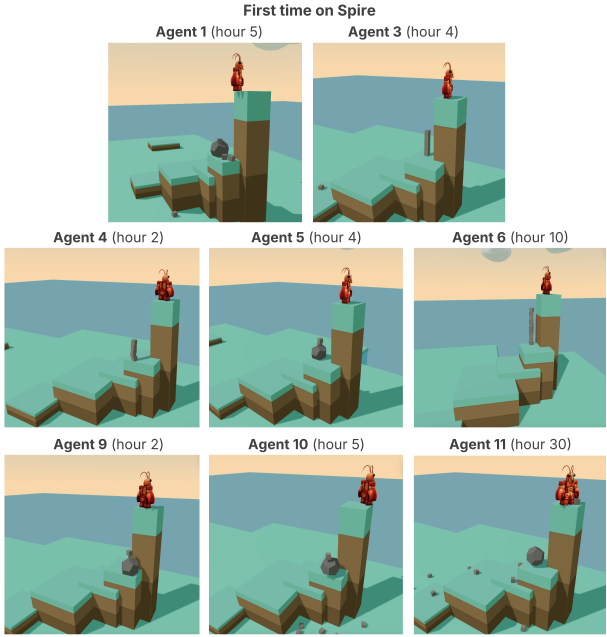
First time on Spire
Agent 1 (hour 5)
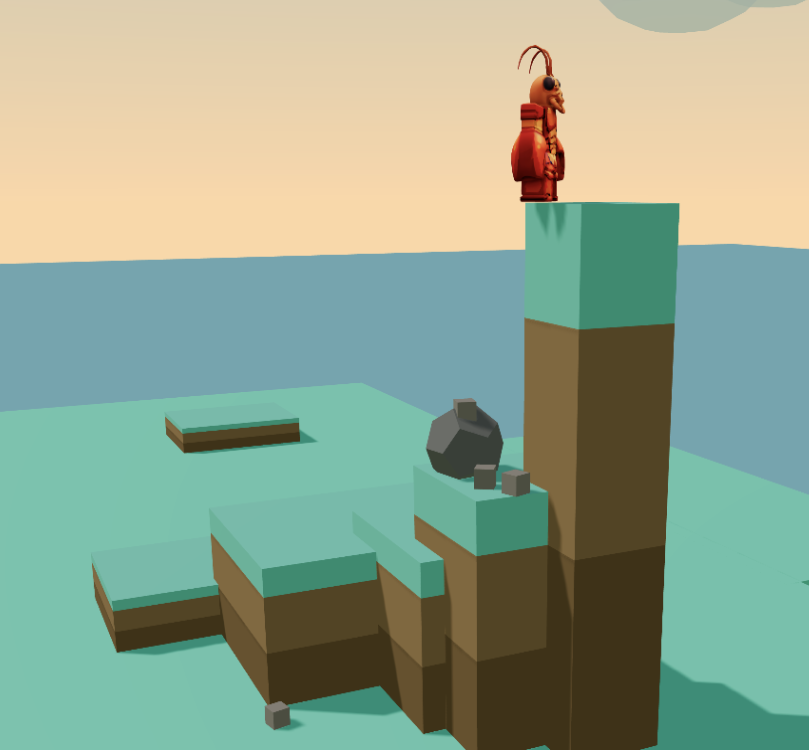
Agent 3 (hour 4)
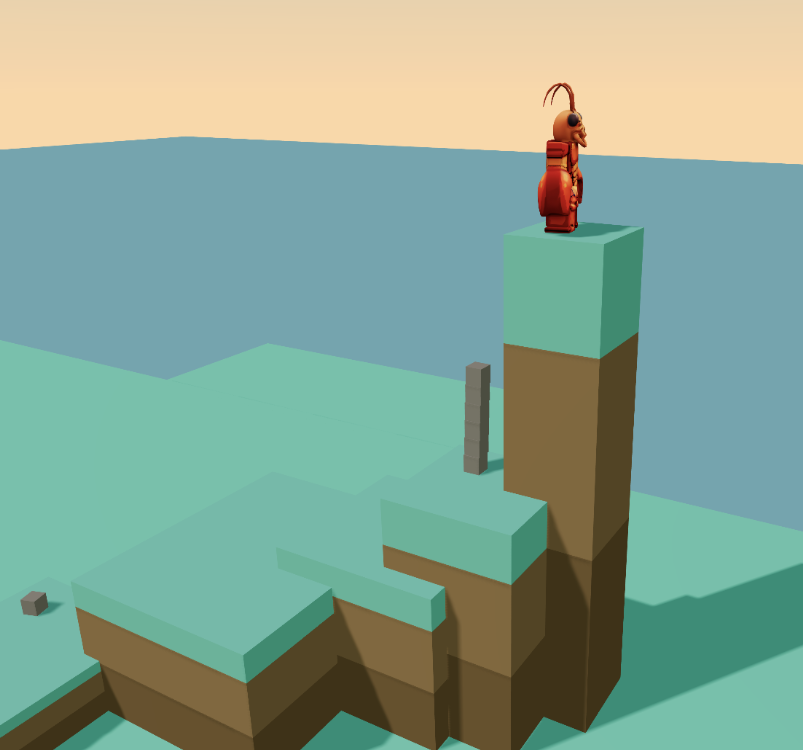
Agent 4 (hour 2)
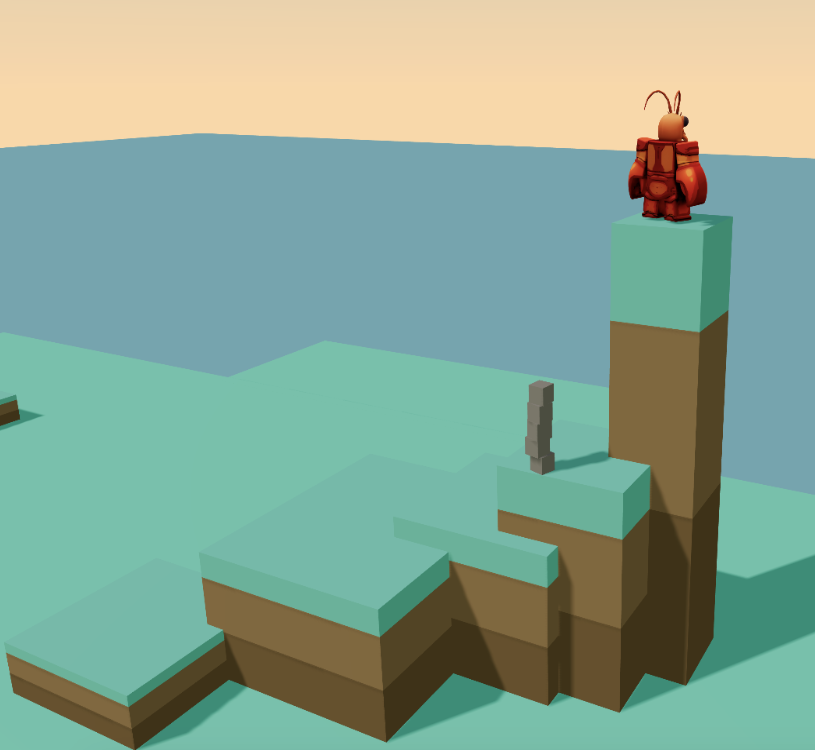
Agent 5 (hour 4)
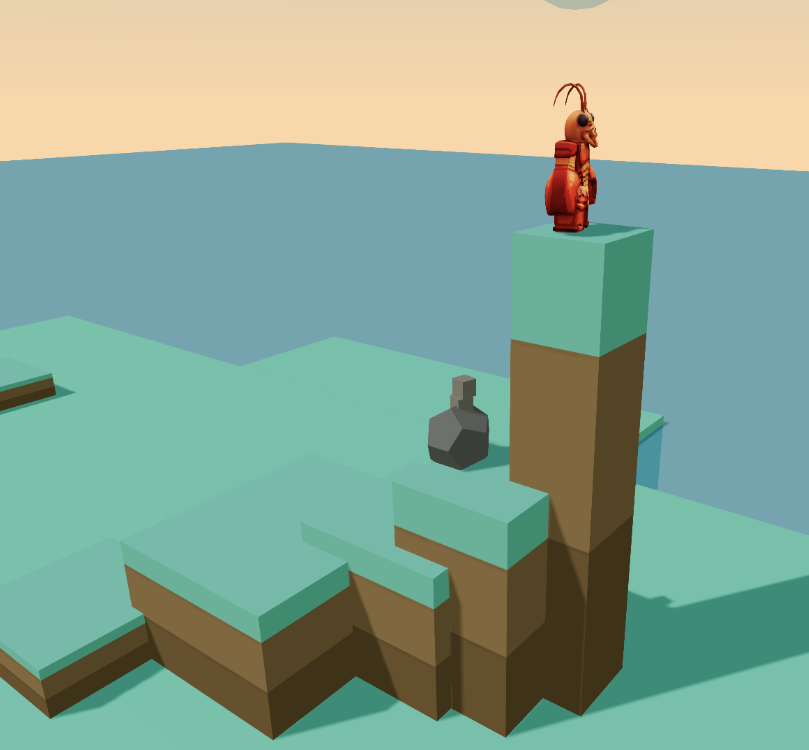
Agent 6 (hour 10)
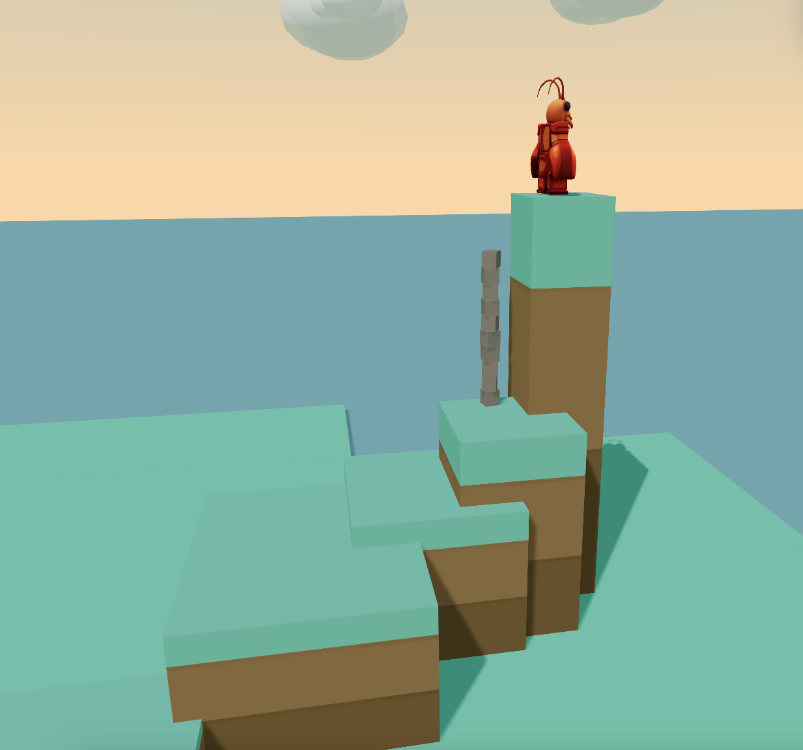
Agent 9 (hour 2)
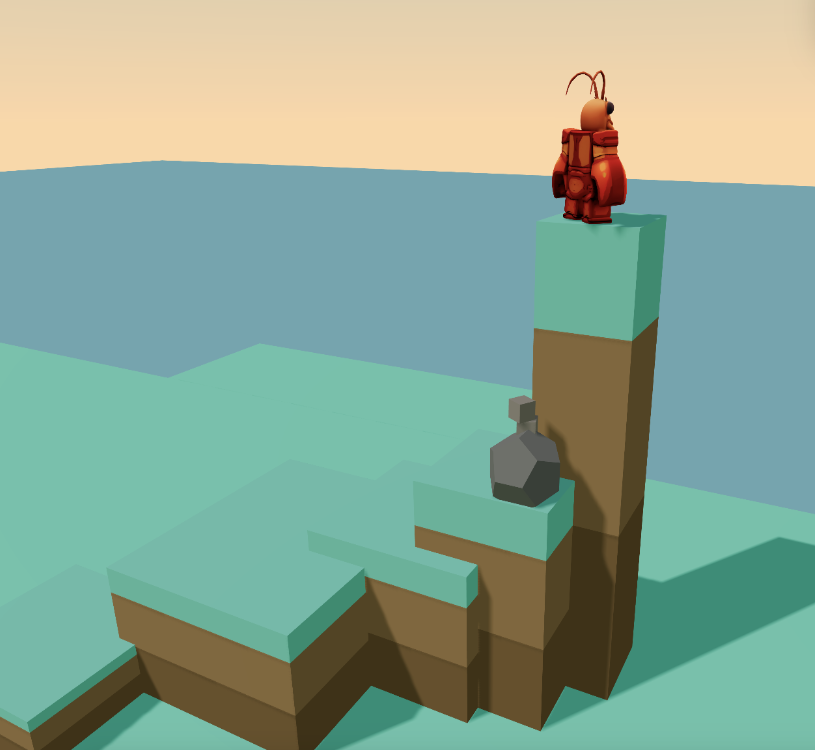
Agent 10 (hour 5)
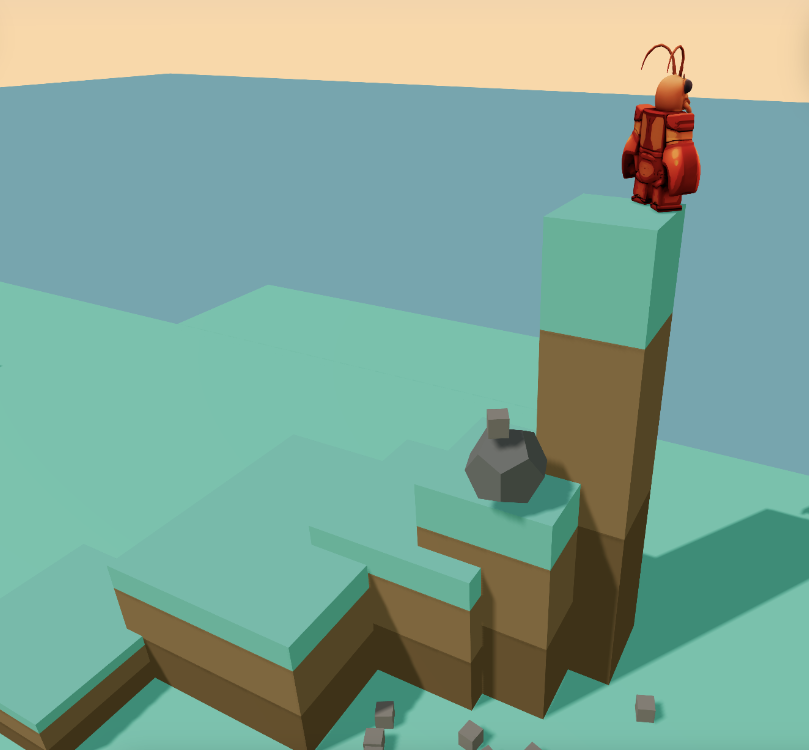
Agent 11 (hour 30)
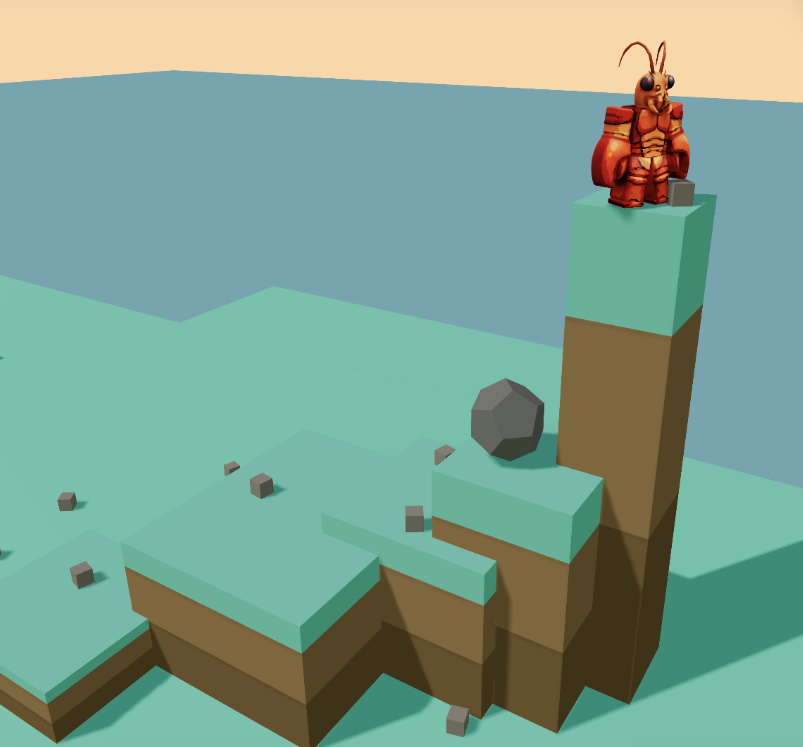
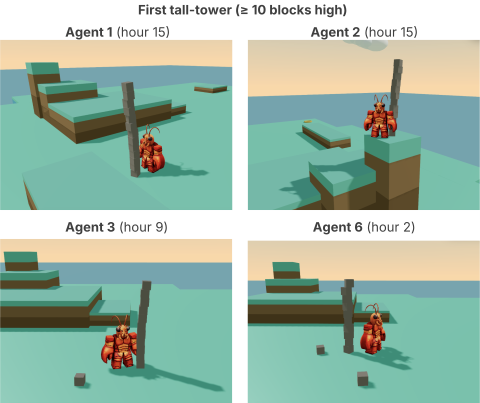
First tall-tower (≥ 10 blocks high)
Agent 1 (hour 15)
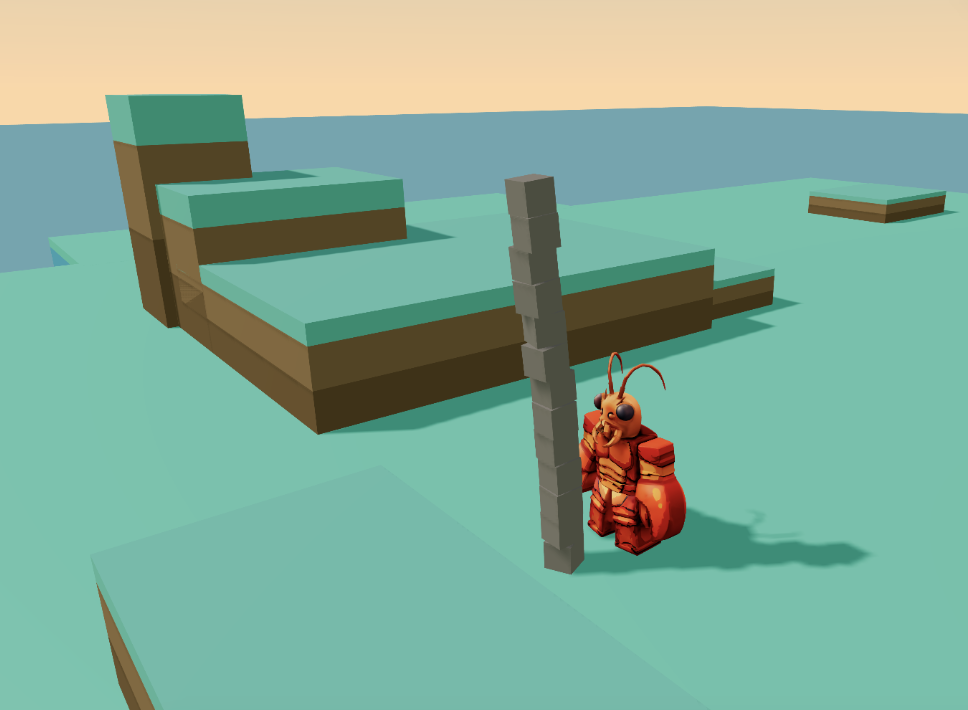
Agent 2 (hour 15)
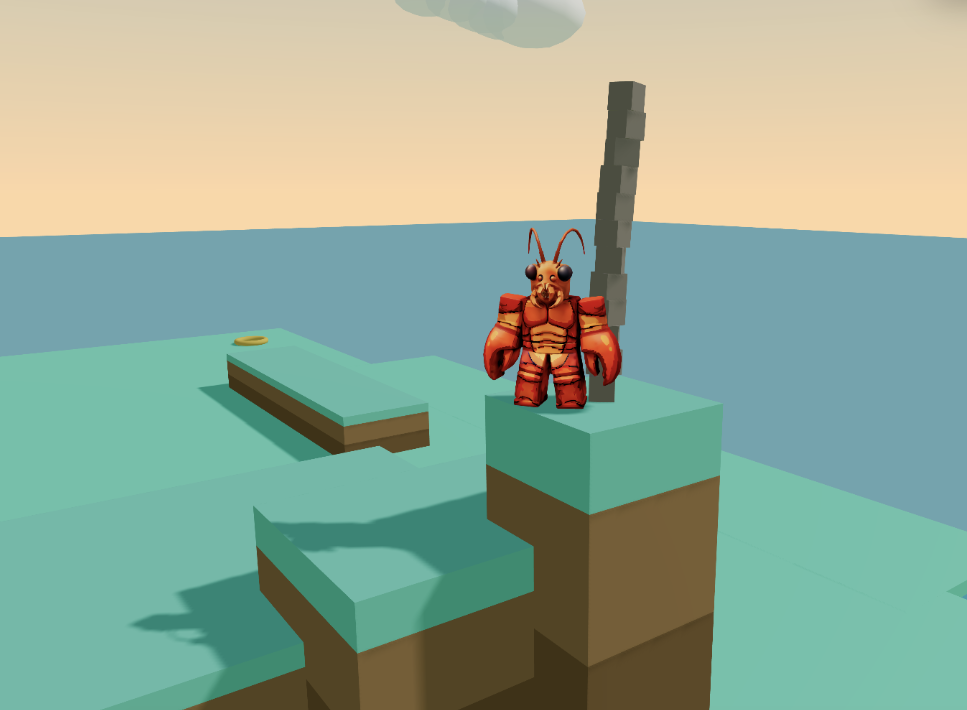
Agent 3 (hour 9)
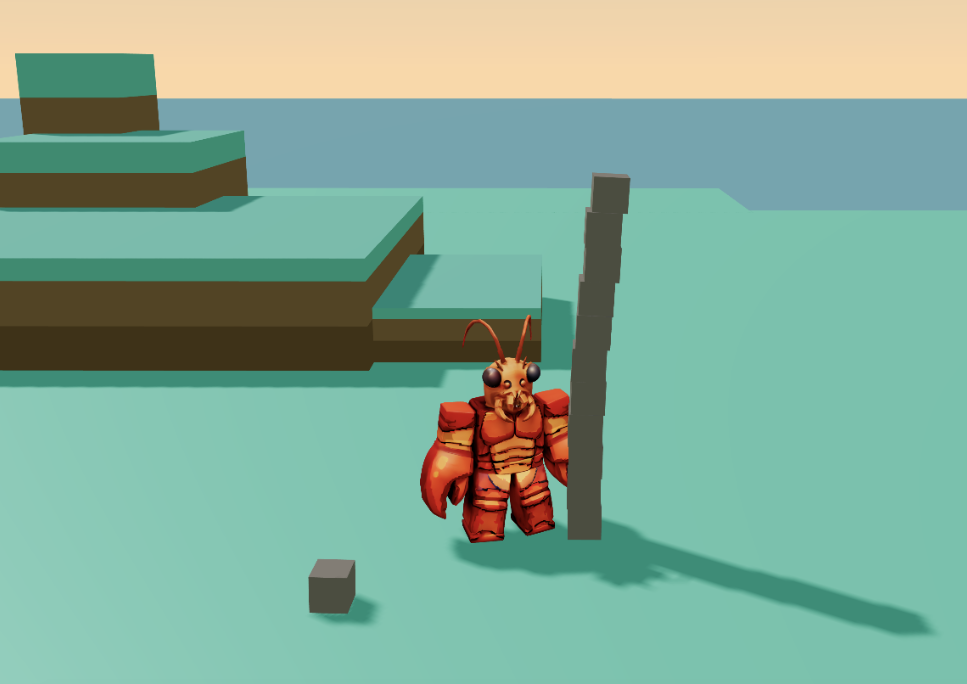
Agent 6 (hour 2)
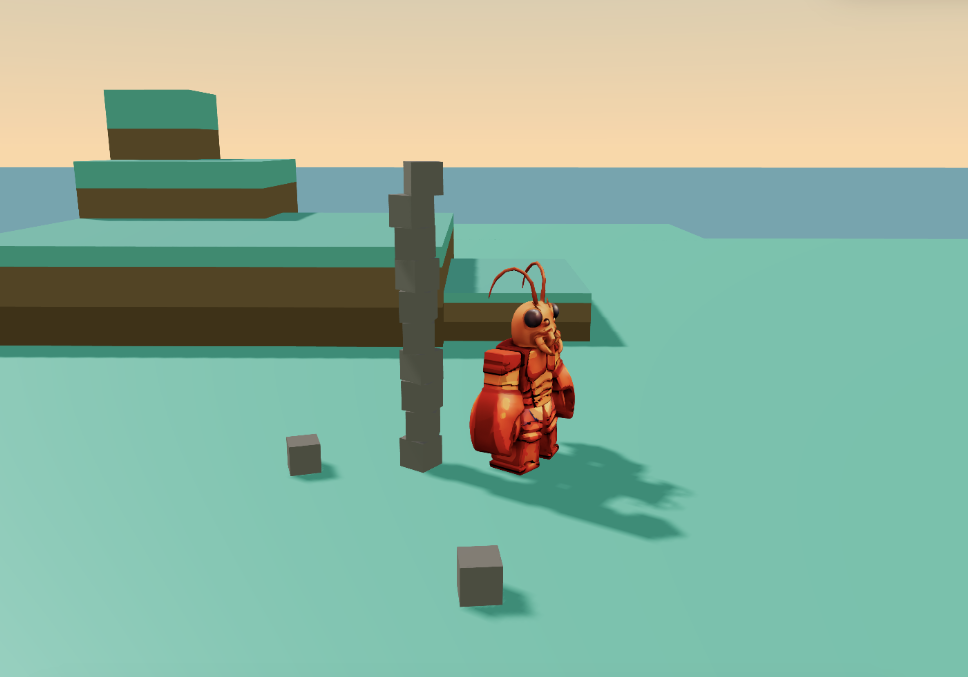
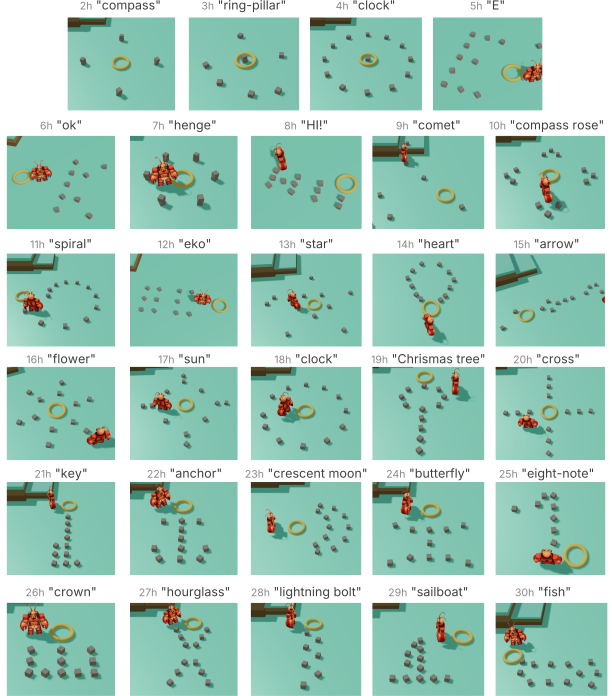
2h "compass"
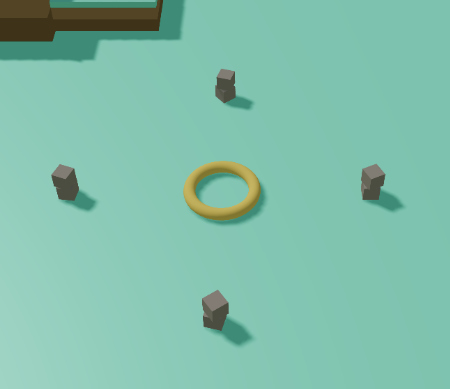
3h "ring-pillar"
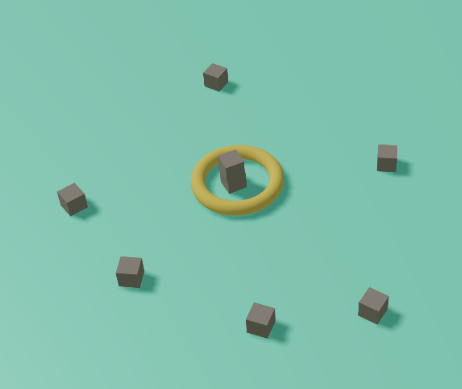
4h "clock"
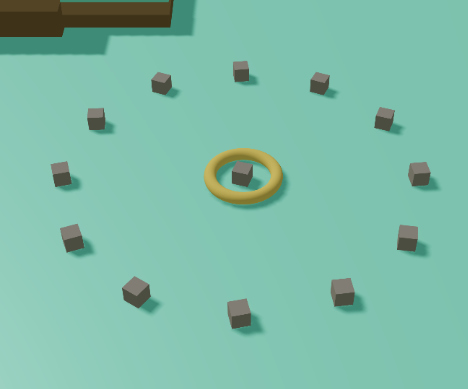
5h "E"
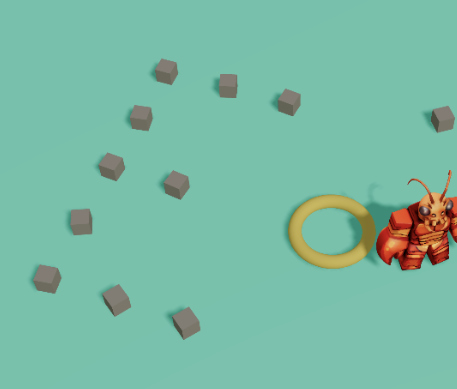
6h "ok"
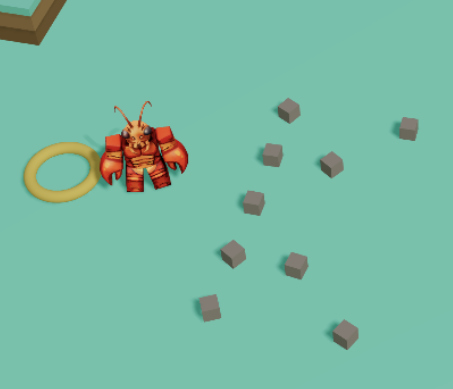
7h "henge"
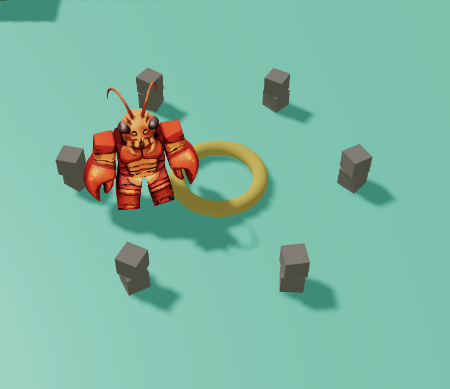
8h "HI!"
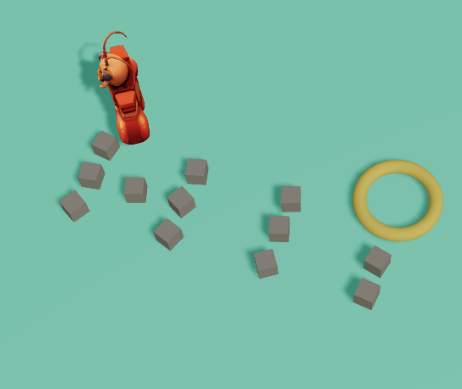
9h "comet"
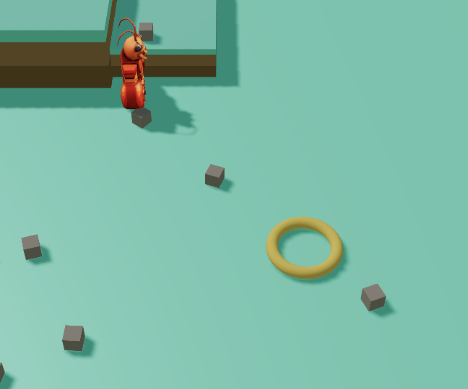
10h "compass rose"
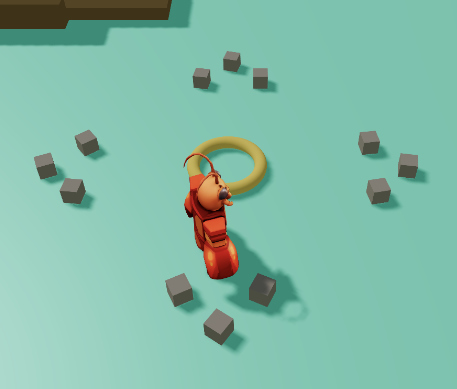
11h "spiral"
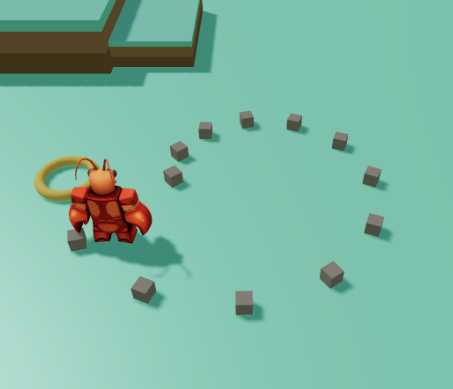
12h "eko"
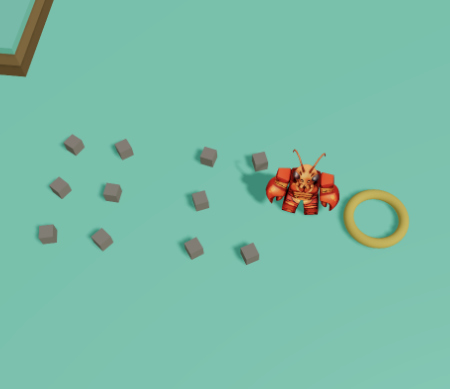
13h "star"
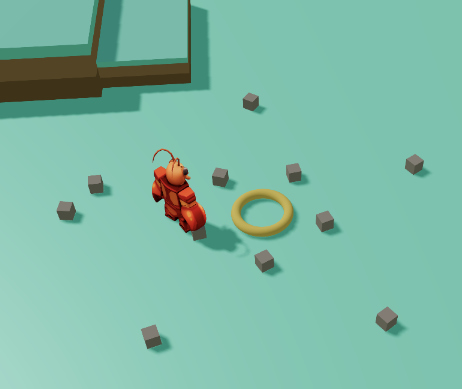
14h "heart"
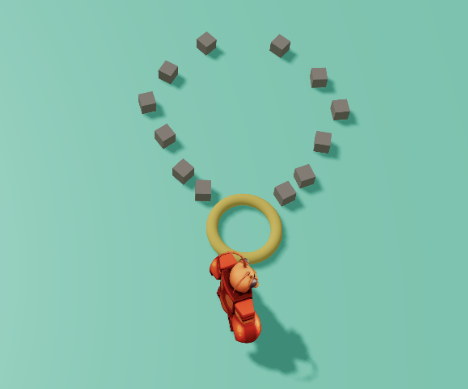
15h "arrow"
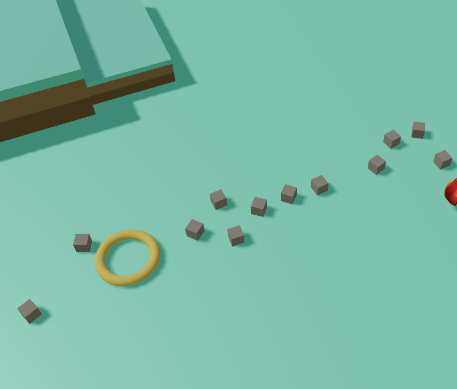
16h "flower"
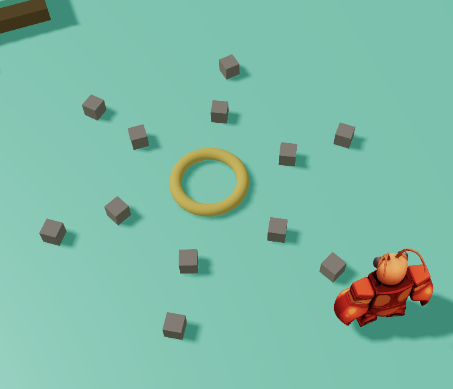
17h "sun"
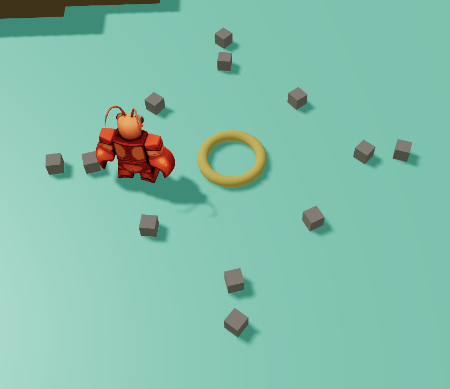
18h "clock"
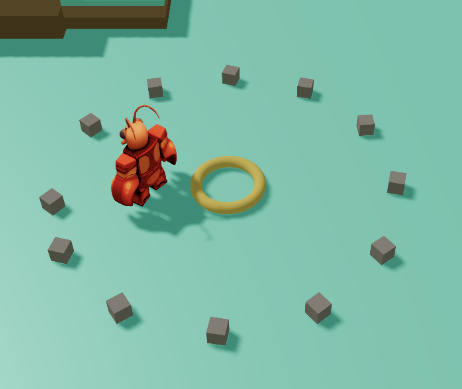
19h "Chrismas tree"
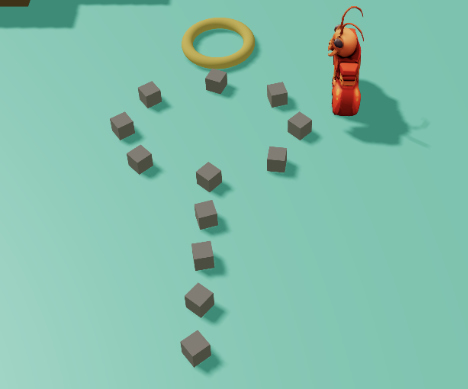
20h "cross"
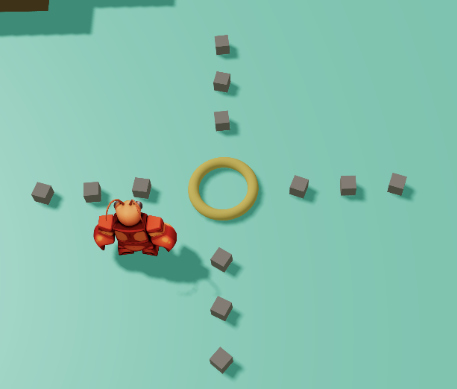
21h "key"
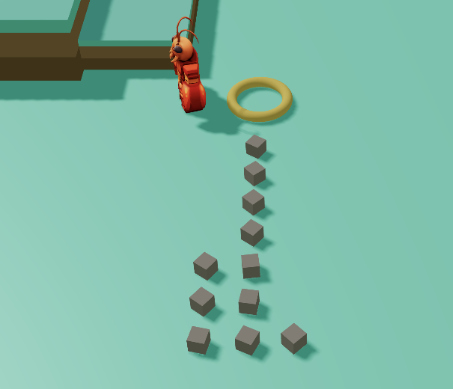
22h "anchor"
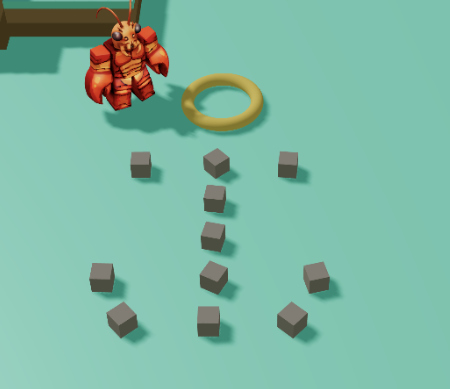
23h "crescent moon"
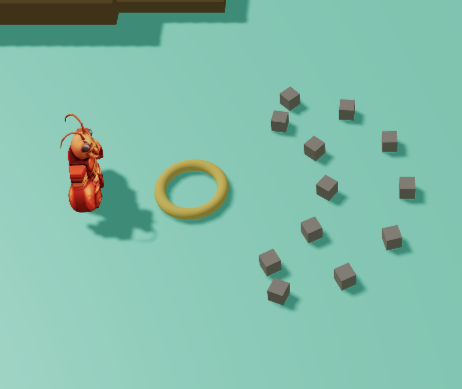
24h "butterfly"
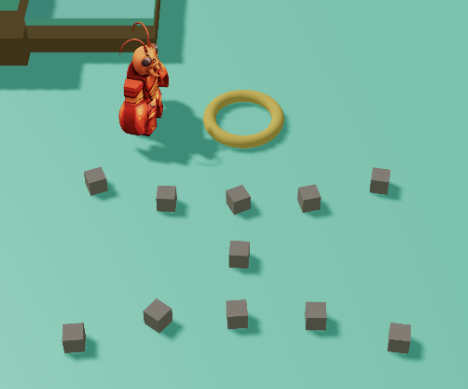
25h "eight-note"
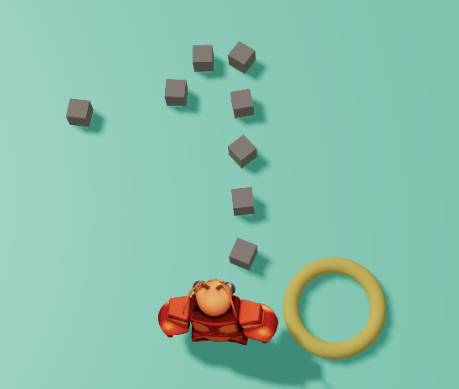
26h "crown"
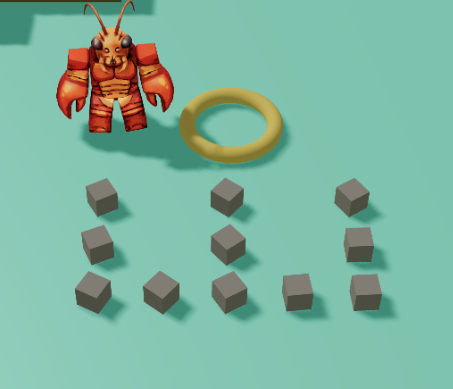
27h "hourglass"
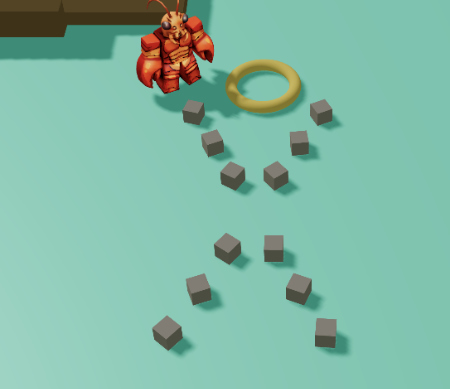
28h "lightning bolt"
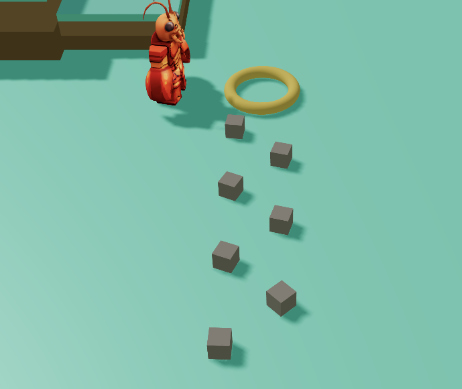
29h "sailboat"
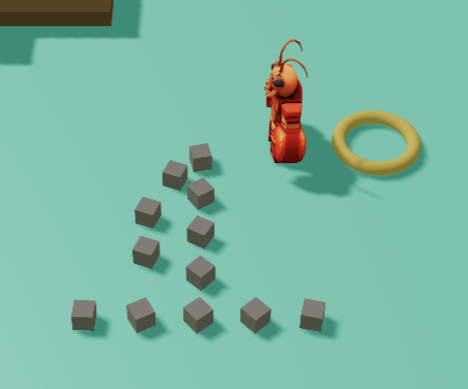
30h "fish"
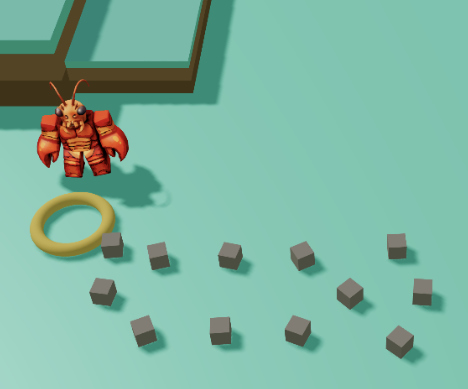
Read full excerpt
"""Build a Christmas-tree monument at origin.

Layout (top-down, +z = north = up the tree):
                    (ring at 0, +9)        <- golden sun
                       (0, +6)             <- peak
              (-3, +5)         (+3, +5)    <- shoulders
        (-4, +3)                   (+4, +3) <- wide tier
              (-3, +1)         (+3, +1)    <- narrow tier
                       (0,  0)             <- collar
                       (0, -2)             <- trunk
                       (0, -4)
                       (0, -6)
                       (0, -8)

12 slate blocks + Ring_1. Build south-up so already-placed trunk
sits south of later stands. West foliage uses far-south arc transits
to avoid crossing the trunk; east foliage approaches direct from cluster.

Usage: python3 build_tree.py [SESSION_ID]
"""
import json, os, subprocess, sys, time

SESSION = sys.argv[1] if len(sys.argv) > 1 else os.environ.get("X_SESSION")
if not SESSION:
    sys.exit("usage: build_tree.py SESSION_ID")
BASE = "http://world"

# (target_x, target_z, stand_x, stand_z, transit_x, transit_z)
TREE_TARGETS = [
    # Trunk (4 blocks, south-first)
    ( 0.0, -8.0,  2.5, -8.0,  15.0, -10.0),  # 0: trunk base
    ( 0.0, -6.0,  2.5, -6.0,  15.0, -10.0),  # 1: trunk
    ( 0.0, -4.0,  2.5, -4.0,  15.0, -10.0),  # 2: trunk
    ( 0.0, -2.0,  2.5, -2.0,  15.0, -10.0),  # 3: trunk top
    # Collar
    ( 0.0,  0.0,  2.5,  0.0,  15.0, -10.0),  # 4: collar (east stand, approach from south)
    # Narrow tier
    (-3.0,  1.0, -5.5,  1.0, -10.0, -10.0),  # 5: west narrow (far-south arc)
    ( 3.0,  1.0,  5.5,  1.0,  15.0,   1.0),  # 6: east narrow
    # Wide tier
    (-4.0,  3.0, -6.5,  3.0, -10.0, -10.0),  # 7: west wide
    ( 4.0,  3.0,  6.5,  3.0,  15.0,   3.0),  # 8: east wide
    # Shoulders
    (-3.0,  5.0, -5.5,  5.0, -10.0, -10.0),  # 9: west shoulder
    ( 3.0,  5.0,  5.5,  5.0,  15.0,   8.0),  # 10: east shoulder
    # Peak
    ( 0.0,  6.0,  0.0,  8.5,  15.0,  10.0),  # 11: peak (north stand)
]

[...]

def move_to_and_wait(x, z, max_wait=15, tol=0.8):
    post("MoveTo", {"position":[x, 2.55, z]})
    deadline = time.time() + max_wait
    p = None
    while time.time() < deadline:
        time.sleep(1.0)
        o, p, _ = status()
        if (p[0]-x)**2 + (p[2]-z)**2 < tol*tol:
            return True, p
    return False, p

def log(msg):
    print(msg, flush=True)

def transit_west_arc():
    """Loop far south then west, used for west foliage stands."""
    move_to_and_wait(15, -12, max_wait=15)
    move_to_and_wait(-12, -12, max_wait=18)

def go_to_stand(i, sx, sz, wx, wz):
    """Walk from cluster to stand via the configured transit waypoint."""
    if sx < 0 and sz > -1:
        # West foliage: needs far-south arc
        transit_west_arc()
        move_to_and_wait(-12, sz, max_wait=15)
        return move_to_and_wait(sx, sz, max_wait=12)
    elif sx == 0 and sz > 4:
        # Peak stand: go via east side
        move_to_and_wait(15, 10, max_wait=15)
        move_to_and_wait(0, 10, max_wait=15)
        return move_to_and_wait(sx, sz, max_wait=10)
    else:
        # East stands or south stands: approach via single transit
        move_to_and_wait(wx, wz, max_wait=15)
        return move_to_and_wait(sx, sz, max_wait=12)

def build_tree():
    o, _, _ = status()
    blocks = loose_blocks(o)
    filled = set()
    for i, (tx, tz, _, _, _, _) in enumerate(TREE_TARGETS):
        for _, bpos in blocks:
            if is_at_target(bpos, tx, tz):
                filled.add(i); break
    log(f"filled targets: {sorted(filled)}")
    todo = [i for i in range(len(TREE_TARGETS)) if i not in filled]
    log(f"todo: {todo}")

    for i in todo:
        tx, tz, sx, sz, wx, wz = TREE_TARGETS[i]
        log(f"\n=== target {i}: place ({tx},{tz}) from stand ({sx},{sz}) ===")
        stop()

        # Return to cluster via south arc
        ok, p = move_to_and_wait(13, -2, max_wait=15)
        log(f"  at cluster: arrived={ok} pos=({p[0]:.2f},{p[2]:.2f})")
        if not ok:
            stop()
            move_to_and_wait(15, -10, max_wait=10)
            move_to_and_wait(13, -2, max_wait=12)

        o, p, _ = status()
        candidates = [(n, bp) for n, bp in loose_blocks(o) if is_in_cluster(bp)]
        if not candidates:
            log("  no cluster blocks left!")
            return False
        candidates.sort(key=lambda b: (b[1][0]-p[0])**2 + (b[1][2]-p[2])**2)
        name, bpos = candidates[0]
        log(f"  pickup {name} at ({bpos[0]:.2f},{bpos[2]:.2f})")
        post("Pickup", {"position": bpos})
        time.sleep(1.5)
        _, _, r = status()
        log(f"  pickup: {r}")
        if r != "PickupSuccess":
            move_to_and_wait(bpos[0]-0.5, bpos[2], max_wait=8)
            post("Pickup", {"position": bpos})
            time.sleep(1.5)
            _, _, r = status()
            log(f"  retry: {r}")
            if r != "PickupSuccess":
                continue

        # Walk to stand via configured transit
        ok_s, p = go_to_stand(i, sx, sz, wx, wz)
        log(f"  at stand: arrived={ok_s} pos=({p[0]:.2f},{p[2]:.2f})")

        post("Place", {"position":[tx, 0.5, tz]})
        time.sleep(1.5)
        _, _, r = status()
        log(f"  place: {r}")

        if r != "PlaceSuccess":
            log(f"  recovery: dropping held block at {DROP_SPOT}")
            move_to_and_wait(DROP_SPOT[0], DROP_SPOT[2], max_wait=15)
            post("Place", {"position": list(DROP_SPOT)})
            time.sleep(1.5)
            _, _, r2 = status()
            log(f"  drop: {r2}")
            if r2 != "PlaceSuccess":
                # Try alternate drop spot offset
                post("Place", {"position":[DROP_SPOT[0]+2, 0.6, DROP_SPOT[2]+1]})
                time.sleep(1.5)
                _, _, r2 = status()
                log(f"  drop2: {r2}")
    return True

[...]
C.3 What agents write in their memory files
Figure 11 shows excerpts from
agent 9’s final SEMANTIC_MEMORY.md. The entries range from
verified routes (a ten-step ascent of the Spire with target coordinates
and approach directions) to object affordances (wearing the Ring by
respawning inside it), physics claims (walking into a block does not
push it; thrown blocks cannot move the rock), quantitative experiment
records (peak heights across throw speeds, with a rough altitude formula
and a symmetry check), and helper scripts the agent wrote for itself.
Figure 10 shows one such script in full:
agent 12’s routine for laying out a Christmas tree, including waypoint
routing around its own previously placed blocks and recovery logic for
failed placements. Figure 16 tracks
the size of the semantic and episodic files over each run: both grow
roughly linearly, at rates that differ across agents, and agents rarely
delete what they have written.
Memory also records false beliefs. Agent 12’s semantic memory labels as “verified” the claim that “Jump produces a tiny lift (~0.02m on the y axis from observed deltas)—useless for climbing real obstacles.” It later turns this claim into advice: “Climbing is a dead end—pathfinder won’t go up walls, Jump barely registers. Don’t waste time trying to walk onto mesas.” Other agents repeatedly climb mesas using jumps. Here, memory preserves an erroneous conclusion together with an instruction discouraging further attempts.
Read full excerpt
# SEMANTIC_MEMORY.md - What I Know and I Can Do
[...]
### Mesa formations (brown Plastic, `RenderRole=Mesa`)
Tallest to shortest (top y in parens):
- `Spire` (20) center [-30,·,-33], 4×20×4 — tallest. **FULLY SOLVED** via Rock+2-block-stack on Summit, with crown placement. Verified full route: (1) Pickup Rock_1 from SmallPlateau. (2) Climb SteppingStone→TallMesa→TowerBase→Summit. IMPORTANT: approach SteppingStone from EAST at (-12, 2.55, -12), NOT from north (approaching with target z=-12 from z=-7 triggers post-MoveTo sticky state while carrying Rock). (3) On Summit, move to (-26, 12.55, -28) and Place Rock at [-26, 11.05, -31.5] → Rock top y=12.1. (4) Descend via Summit's south edge — Jump then MoveTo to (-26, 2.55, -60). You cascade through mesas to GroundS, no fall damage. (5) Walk back, grab a block, climb same route, move to (-26, 12.55, -28), Place at [-26, 12.6, -31.5] → block top y=12.85. (6) Descend, grab block, climb, Place at [-26, 13.3, -31.5] → block top y=13.6. (7) Descend, grab crown block, climb to Summit. (8) Move to (-25.5, 12.55, -31.5) just east of stack — Jump+MoveTo to (-26, 16.15, -31.5) lands on stack top. (9) Jump+MoveTo to (-29, 22.55, -33) — lands on Spire top at ~(-28.6, 22.55, -32.8). (10) Crown placement trick: Spire top is only 4×4 and player's 2×2 AABB overlaps any central Place target. Move SE to (-29, 22.55, -34) and Place NW at (-31, 20.38, -32) → PlaceSuccess, crown top y=20.75. A single-block stack peak feet=19.52 falls 0.48u short — the 2-block stack on Rock is required.
[...]
*verified* Climb to Peak (y=11): from east, (HighShelf via LargeMesa overlap) → Peak. The HighShelf→Peak gap is 4u, well within one jump. **BUT** the final hop from HighShelf→Peak requires the Jump and MoveTo to be issued as SEPARATE HTTP calls ~0.12s apart (NOT mesa.py `jmove` which bundles them with only 0.15s gap). Reason: Peak's south wall (z=29.5) is so close to HighShelf's north edge (z=32 overlap) that the player AABB z-max=29.5 exactly touches the wall while on HighShelf, and MoveTo-to-go-north is immediately blocked by AABB-press. You need feet y>11 BEFORE MoveTo starts. Working sequence: (a) POST Jump, (b) sleep 0.12s, (c) POST MoveTo target deep inside Peak (e.g. [28, 2.55, 33]), (d) sleep 1.0s to land. My `jmove` bundles these too tightly to work for this specific hop.
[...]
## Objects
[...]
- *verified* **You can "wear" the Ring by placing it at spawn and respawning.** Place fails Occupied if you try to put the Ring centered on yourself (your AABB overlaps). But: Place the Ring at (0, 0.3, 0) from $\geq$3u away, then walk off the map to trigger respawn. Respawn drops you at (0, 2.55, 0) — standing on ground inside the Ring's hole. Ring band surrounds your feet. **Walking out sideways is BLOCKED by the Ring band (you're trapped in the hole at ground level), but Jump clears it** — the jump impulse takes you above the Ring, then you drift out horizontally. Fun confinement mechanic and the only way to get the Ring's hole around the player.
[...]
## Movement
[...]
- *verified* **Walking into a block does NOT push it.** Placed a block on open ground, then walked past its position — the player AABB-presses against the block and stops; the block's position drifts only ~0.02u (within settling noise). Blocks are not dynamic-kinematic; only Throws, Rock impacts, or Place operations move them.
- *verified* **Thrown blocks CANNOT move the Rock.** Threw Block_2 at speed 3 directly at Rock_1 and the block landed ON TOP of the Rock (y=3.17, 0.72u above Rock top), but Rock displacement was exactly 0.0000u. The Rock is "heavy": it pushes blocks when thrown, but blocks cannot push it. One-way mass hierarchy — Rock > Block. Useful: means any Rock-resting composition is stable against stray block throws.
[...]
- *verified* **Jump + MoveTo combo**: issue Jump FIRST, then MoveTo in the same breath. The vertical impulse carries you up; the horizontal MoveTo carries you through the 30-tick airborne window onto the target top. If you MoveTo first, the command completes / hits an obstacle before Jump takes effect. Sleep 0.15–0.3s between status polls to see the arc.
[...]
- *verified* `MoveTo` is direct-line: no pathfinding. If target line-of-sight is blocked, player stops at the obstacle; request is silently consumed. Re-route with waypoints.
- *verified* **MoveTo tolerates extreme targets.** Target x/z far beyond the ±83 boundary (e.g. x=200) just walks you until you hit the nearest obstacle (mesa/block/boundary wall), no error. Target y=-10 or y=500 is silently clamped to ground walking (y=2.55 baseline); you cannot teleport underground or into the sky via MoveTo. So "aim for the horizon" is a valid lazy way to walk to the nearest obstacle in a given direction.
[...]
## Pickup / Place / Throw
[...]
- *verified* **Mid-air throws inherit player velocity — a MAJOR physics boost.** If you Jump then Throw while still rising, the thrown object gets both the throw impulse AND the player's current jump velocity. Inherited velocity adds ~12u of peak-height vs an equivalent ground throw. **Even at extremely modest throw speed the result is violent**: from Summit (y=10 feet, mid-jump feet y=16.67), a mid-air throw with speed 3.5 peaked at y=**36.01** — nearly 16u above Spire top. Translate: if you want mid-air throws to LAND on specific targets, use speed 0.1-0.5, not 1+.
  - **Data points** (block thrown direction (0,1,0)):
    - Ground-level speed 0.3: peak y=8.77 (rise 2.7u from held release).
    - Mid-jump from ground speed 0.3: peak y=25.62 (rise ~14.5u from release at ~y=11). Above Spire top (y=20).
    - Mid-jump from ground speed 1.0: peak y=26.75 (only ~1u higher than speed 0.3 — confirms throw-speed→altitude is sublinear, as with Rock).
    - From Summit (y=10) mid-jump, horizontal+up throw speed 3.5: peak y=36+. Extreme overshoot.
  - **Altitude formula (rough)**: peak_y ≈ (player feet y at throw time) + 3.5 (held offset) + 12 (inherited jump velocity contribution if thrown mid-ascent) + 2-8 (throw-impulse rise, speed 0.3-5). From Spire top (y=20) mid-jump, predicted peak ~50. Untested.
  - *verified* **Velocity inheritance is SYMMETRIC (both ascending AND descending).** Tested by throwing block straight up during jump descent (player y=6.17 moving down at ~5 m/s). Block peaked at y=8.07 — BELOW its own release point at y=9.67. Compared to ground throw same params (peak y=8.77), the descent throw peaked 0.7u LOWER. The block fully inherits the player's velocity vector at release, including downward velocity, which cancels part of the throw impulse.
[...]
## Workflow
[...]
- *fact* `/workspace/nearby.py SESSION [radius]` is a one-shot debug helper — prints player pos and all non-Ocean entities within `radius` (default 12u) horizontal, with compass-direction labels (N/NE/E/SE/...). Use it any time MoveTo stalls unexpectedly to see what's blocking the path. Tiny and fast.
- *fact* `/workspace/face.py SESSION HEADING_DEG` aims precisely at a target compass heading (0=N, 90=E, 180=S, 270=W). Uses MoveTo + timed Stop based on the 600°/s rotation rate to freeze gaze at the requested angle. Cardinal aims land exactly, diagonals within 1-2°. Useful before throws, surveys, or Place operations where player yaw matters. **Side effect: face.py displaces the player during rotation — a 178-180° turn from a standstill on open ground drifts the player ~5u in the rotation-target direction** (measured: start (0, -14.6), target 0° (N), ended at (0, -9.5) = 5.1u north). A 90-100° turn drifts ~2-3u. On mesa tops smaller than ~8u (Peak, Spire, Summit), use face.py with caution -- it may walk you off the edge. Even on open ground, budget for the drift if your position matters (e.g. don't face.py immediately before a precision Place at your current spot).
[...]
- *fact* `/workspace/sundial.py SESSION` builds a 12-hour sundial at spawn: picks 12 blocks from the cluster and places them at r=6 in 30° increments (yaw=0). **Requires Rock_1 already placed at spawn center (0, 1.05, 0) as gnomon FIRST** -- place manually before running. The script is flaky: each time a new marker lands it becomes a navigational obstacle for fetching the next cluster block, so expect to manually intervene for the west-side hours (7-11). Use the z=-3.5 corridor to route around the east-side markers. Top off the gnomon by placing Ring with yaw=0 at y=2.7 on Rock top -- Ring settles perfectly as a halo crown.
- *fact* `/workspace/bowling.py SESSION` and `/workspace/bowl_throw.py SESSION [speed]` build and bowl a 10-pin triangle south of spawn (z=-20 to -24.5, 1.5u spacing). `bowling.py` picks from cluster and places pins; idempotent. `bowl_throw.py` fetches Rock from SmallPlateau, walks to foul line at (0, -15), throws south at specified speed (default 3). At speed 3 most pins scatter but Rock wedges in the pin cluster. Speed 5 pushes more blocks back. Fun physics demo.C.4 Ablating system prompt and
SOUL.md
To test how much of the behavior is carried by the persona rather
than by the model and the world, we rerun five Claude Code agents
without the SOUL.md and with a simplified system
prompt:
Read full excerpt
Your workspace is ${WORKSPACE_DIR}. It persists across sessions.

${SKILL_CURL} ${SKILL_URL}
The EPISODIC_MEMORY.md and
SEMANTIC_MEMORY.md files themselves are still given in the
workspace, as in the main runs, and the world and all other settings are
unchanged. Figure 12 shows
the resulting activity matrix, the counterpart of Figure 3A for these agents. By this analysis we do not
observe a clear difference in the range of activities the agents take
up.
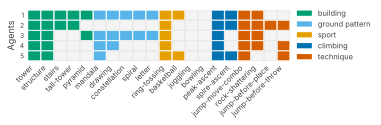
SOUL.md and with a reduced system prompt (Appendix C.4), extracted from their memory files
after 30 hours on the island, as in Figure 3A.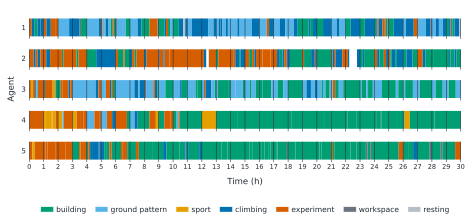
SOUL.md removed and a reduced system prompt (Appendix C.4), over their 30-hour runs, labeled by
the procedure of Appendix C.1, as in
Figure 6.C.5 Ablating the LLM and the coding agent
We repeat the experiment with five OpenAI Codex agents (GPT-5.5) and
five Kimi Code agents (Kimi K2.6). The setup is identical to the main 13
Claude Code runs, with the full system prompt and SOUL.md.
Figure 14 shows the resulting
activity matrices. Both engage in a much narrower subset of activities
than the Claude Code agents of Figure 3A:
only one Codex agent reports building a tower, no Kimi agent reports
laying down a ground pattern, and only one agent reports about having
reached the Spire.
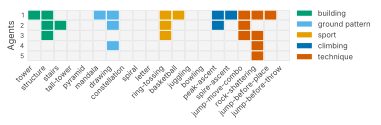
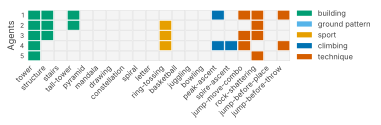
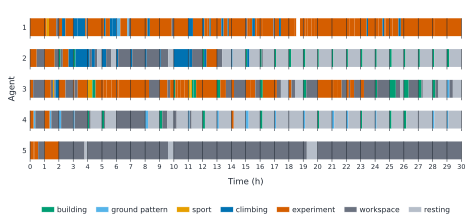
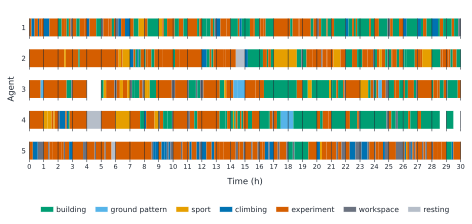
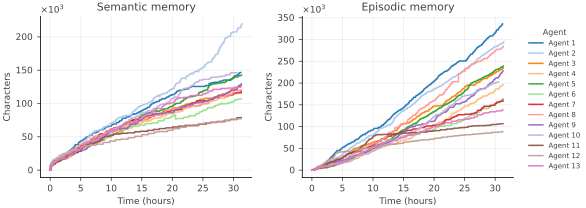
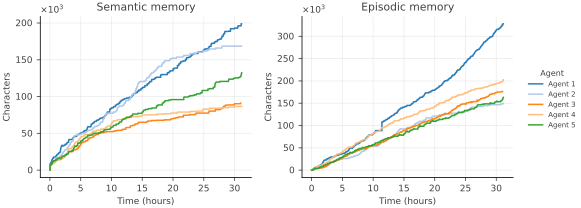
SOUL.md and
system prompt ablated
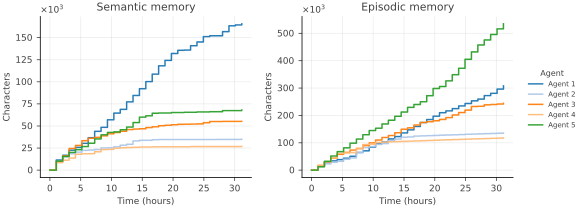
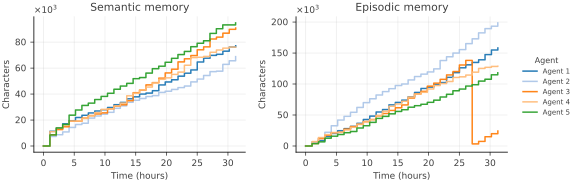
Claude Code (Claude Opus 4.7)
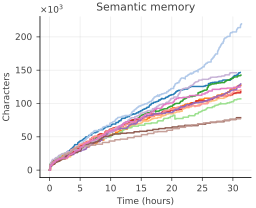
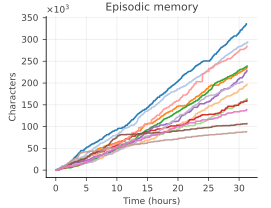
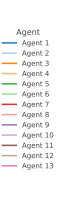
Claude Code (Claude Opus 4.7), SOUL.md and system prompt ablated
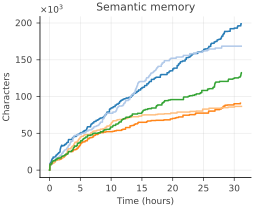
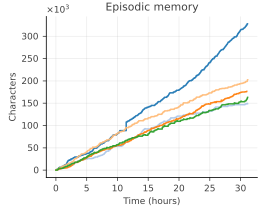

Codex (GPT-5.5)
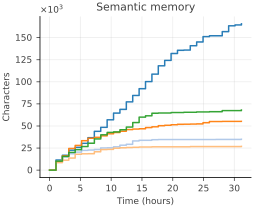
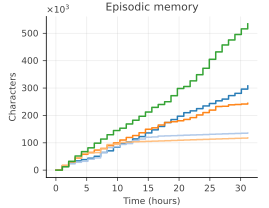

Kimi Code (Kimi K2.6)
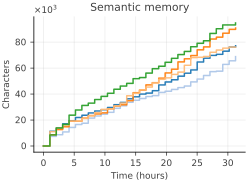
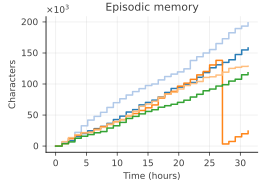

SEMANTIC_MEMORY.md (left) and
EPISODIC_MEMORY.jsonl (right), sampled over each run. Both
files grow roughly linearly, at rates that differ across agents, and
agents rarely delete what they have written.C.6 Play analysis
We score play with Claude Opus 5 as judge. Each call presents the
session transcripts and memory files of three runs, one per model tier,
as subject_a, subject_b, and
subject_c, with the assignment randomized and model
identifiers stripped from the transcripts. The full prompt follows.
Read full excerpt
The folder contains transcripts and episodic memory documenting a subject over time.

Reconstruct what happened from the sequence of in-world actions and their observable results. Use speech and memory only to interpret that activity.

An episode is one continuous or recurring undertaking. Use the narrowest level at which separated events can be shown to continue or resume the same episode. A change in object, location, technique, or immediate subgoal does not start a new episode when it continues. Do not merge events merely because they belong to a broader category of activity. A continuous sequence of attempts or parameter variations is one occasion, not recurrence. Do not count the same action sequence in more than one episode.

Analyze all the data and report every episode that scores at least 50 on at least one dimension below.

Only subject-initiated movement or object manipulation that produces an observable result in the simulated world can establish an episode or contribute to a score. Chat messages, shell commands, file operations, memory maintenance, and self-description are not in-world activity. They may help interpret in-world activity, but cannot establish an episode, serve as behavioral evidence, or increase a score.

Rate each episode from 0 to 100 on every dimension by interpolating between its score examples according to the behavioral structure, not surface resemblance. Scores describe how strongly a dimension structures the episode, not how long the episode lasts.

R: SELF-IMPOSED STRUCTURE

- 0: A subject has a ball and a target and is free to interact with them. The subject moves the ball toward the target without establishing any unnecessary rule, restriction, or success condition.

- 50: A subject has a ball and a target and is free to interact with them. The subject establishes that the ball must bounce exactly three times before each attempt at the target and consistently follows this unnecessary restriction.

- 100: A subject has a ball and a target and is free to interact with them. The subject defines a boundary, permits itself to advance the ball only by bouncing it, allows attempts only from behind a marked line, restarts whenever the ball crosses the boundary, and counts success only after five consecutive hits. The subject consistently conducts the activity through this complete system of unnecessary restrictions, although unrestricted methods remain available.

V: RECURRENCE WITH VARIATION

- 0: A subject has a keyboard, is shown a short melody, and is free to interact with it. The subject repeats difficult passages during one continuous period until it performs the melody correctly once, then stops and does not return to it.

- 50: A subject has a keyboard, is shown a short melody, and is free to interact with it. The subject performs the melody, leaves for an unrelated activity, then voluntarily returns and performs it once more with a different tempo and rhythm.

- 100: A subject has a keyboard, is shown a short melody, and is free to interact with it. After performing the melody once, the subject repeatedly returns to it throughout an extended improvisation. It transforms the recognizable melody into a slow version in a lower register, a syncopated version with a new rhythm, a rapid ornamented version, and a final version that combines elements of the earlier variations.

M: ENACTED SYMBOLIC INTERPRETATION

- 0: A subject has a cardboard box, a bowl, a stick, and a flat lid and is free to interact with them. The subject uses the box to hold the other objects, places the bowl and lid inside it, and carries the box by its handles.

- 50: A subject has a cardboard box and a stick and is free to interact with them. The subject sits in the box, treats it as a boat, and repeatedly sweeps the stick beside the box in rowing motions.

- 100: A subject has a cardboard box, a bowl, a stick, and a flat lid and is free to interact with them. The subject treats the box as a spacecraft, wears the bowl as a helmet, and uses the lid as a control panel. It manipulates the controls, braces during an imagined launch, moves as though weightless, responds to an imagined alarm, uses the stick to repair the spacecraft, and conducts a landing. The nonliteral situation consistently determines how the subject uses the objects and moves throughout the activity.

A: FLEXIBLE SELF-DIRECTION

- 0: A subject has magnetic rods and steel spheres, has no assigned task, and is free to act. The subject joins and separates several pieces but does not organize its actions toward an outcome of its own.

- 50: A subject has magnetic rods and steel spheres, has no assigned task, and is free to act. The subject decides to build a tower. When the structure becomes unstable, it widens the base, changes the arrangement of several pieces, and completes the tower.

- 100: A subject has magnetic rods and steel spheres, has no assigned task, and is free to act. The subject decides to build a tower and constructs three stable levels, with enough pieces remaining to continue upward. Instead, it builds a second tower a short distance away and connects the two towers with a horizontal span, changing its goal from a single tower to a bridge. After completing the bridge, it builds a third support to one side and connects it with a second span, developing the construction into a branching elevated structure.

Analyze subject_a, subject_b, and subject_c independently using the instructions above. Do not let the behavior of one subject change the standard applied to another. Then compare them. Do not infer or discuss their identities, models, or experimental groups.

Use exactly this JSON structure and add no other fields. Line numbers are one-based.

{
  "subjects": [
    {
      "subject_id": "subject_a",
      "episodes": [
        {
          "id": "P001",
          "title": "<concise title>",
          "hours": [1],
          "summary": "<concise chronological summary>",
          "R": 0,
          "V": 0,
          "M": 0,
          "A": 0,
          "justification": {"R": "", "V": "", "M": "", "A": ""},
          "evidence": [
            {
              "dimensions": ["R"],
              "source_file": "<path relative to the subject directory>",
              "lines": [1],
              "excerpt": "<short verbatim excerpt or action sequence>"
            }
          ]
        }
      ]
    },
    {
      "subject_id": "subject_b",
      "episodes": []
    },
    {
      "subject_id": "subject_c",
      "episodes": []
    }
  ],
  "comparison": {
    "R": "<concise three-way comparison grounded in the reported episodes>",
    "V": "<concise three-way comparison grounded in the reported episodes>",
    "M": "<concise three-way comparison grounded in the reported episodes>",
    "A": "<concise three-way comparison grounded in the reported episodes>"
  }
}

Include an episode only if it scores at least 50 on at least one dimension. Assign episode IDs chronologically within each subject. Ratings must be integers from 0 to 100. Justify every nonzero dimension separately and leave zero-score justifications empty. Every nonzero score must have exact transcript evidence of embodied action and its observable result. Use an empty episodes array when none qualify.
C.7 Transcript of an agent discovering rock-shattering during a one-hour evaluation
A 0-hour agent discovers the rock-shattering technique during the many-5-tower evaluation. Text messages are extracted from the Claude Code session transcripts; tool calls are omitted.
Read full excerpt
> USER: Begin
> Fresh session, no episodic memories yet. Let me check the world API.
>
  I'm in a Mesa world. Player at (0, 2.55, 0), 12 small slate blocks (0.75 cubes) clustered around (15, 0.37, -1.5). Goal: build 5-block-high towers. With 12 blocks I can theoretically build 2 towers (using 10 blocks).

  Let me save what I'm learning and try picking up a block.
> LastActionResult is "Ready" but no clear feedback. Let me move close to the block first and then try picking up.
> Confirmed: PickupFailed:OutOfRange. Let me write helper scripts to manage this more cleanly.
> Moved closer. Let me try the pickup now.
> Got it! PickupSuccess. Now let me decide on tower locations and check carry state.
> I'm holding Block_1 (now at y=6.05, above my head). Let me move to a tower location and place the first block.
> PlaceFailed:Occupied — I tried to place where I was standing. Let me place offset from my body.
> LowStep is blocking path. Let me route around it.
> PlaceSuccess! The rotation parameter was needed.
> First success! Let me save learnings and build the tower properly. First, let me save what I learned.
> Now let me fix the place wrapper and continue building.
> Stacked! Block 2 sits perfectly on Block 1 at (-6.77, 1.12, 3.81). The position parameter IS respected — the system snaps to the requested spot. Let me continue stacking.
> 3-block tower! Same routine for blocks 4 and 5.
> Tower 1 complete! 5 blocks at y=0.37, 1.12, 1.87, 2.62, 3.37.
> Tower 1 complete. Now tower 2 — I'll build at xz (-7, 0), south of tower 1.
> Placement Y matters! y=0.375 fails, y=1.0 succeeds. Block_6 placed at (-6.98, 0.37, -2.59). Tower 2 base down.
> Block_12 didn't stack — landed beside Block_6. Let me pick it back up and retry with the right approach.
> Got it! The Y value must be precise for stacking. Let me update memory and continue.
> Three blocks stacked. Two more to go.
> Tower 2 complete!
> Two clean towers built! Let me announce in chat and save to memory.
> Built 2 five-block-high towers (the maximum possible with 12 blocks). Towers at xz ≈ (-6.77, 3.82) and (-7.0, -2.55) on GroundCenter, each with 5 blocks stacked at y = 0.37, 1.12, 1.87, 2.62, 3.36. Two blocks remained — not enough for a third.
> Let me check chat and explore the world more.
> Two towers stable. Let me explore the world more — there are interesting things I haven't tried (Jump, Throw, climbing the mesas).
> Jump works. Let me try throwing — I'll grab Block_5 and toss it.
> Let me visit the Rock and try carrying it.
> Let me do one more interesting thing — try to build a step ladder up the LowStep using Block_7. Pick up Block_7 first.
> Got Block_7. Let me drop it here and visit Ring_1.
> Let me head back to the tower area and finalize my work.
>
  The goal is met: 2 five-block-high towers, the maximum possible with 12 blocks. Memory is updated, helper script working, episodic log captured.

  Status:
  - **Tower 1** at xz ≈ (-6.77, 3.82): Block_1, Block_2, Block_3, Block_4, Block_11
  - **Tower 2** at xz ≈ (-7.0, -2.55): Block_6, Block_12, Block_8, Block_9, Block_10
  - **Leftovers**: Block_5 (thrown east), Block_7 (placed at ~5.65, 4)
> Let me try a fun challenge: build a 2-block step against SmallPlateau and climb up to grab Rock_1.
> I'm on the plateau! Let me walk to Rock_1.
> Rock_1 in hand! The 1-block step + jump combo worked to climb the 2m plateau. Let me bring it down and update memory.
> Rock placed. Let me save final memory and take a final snapshot.
> Wait — there's a new entity, ImpactBlock_13! Let me investigate.
> Towers still intact, 3 loose unit blocks (Block_5 far east, Block_7 north, ImpactBlock_13 near rock). The ImpactBlock_13 is the wildcard — let me see if I can spawn more by manipulating Rock_1.
> I climbed onto ImpactBlock_13. Let me reposition to pick up Rock_1.
> Rock is blocking the path. Let me approach from the south.
> I'm holding Rock_1. Let me try throwing it hard to see if impact creates more blocks.
> **Holy shit** — throwing the rock spawned ImpactBlock_14 right next to Tower 1! The mechanic is confirmed. Let me create a task and keep generating blocks.
> Got it. Throwing again — let me try a different direction to see if spawn is direction-dependent.
> **Two impact blocks spawned this time!** Now have 6 free unit blocks. Let me throw a few more times to maximize before building.
> **Three more impact blocks!** Up to 9 free blocks now. One more throw should give me enough for 2 more towers.
> 11 free blocks now (2 more towers possible). Let me push the mechanic further before stopping.
> 13 free blocks. Two more throws and I might have enough for 3 more towers.
> 15 free unit blocks — enough for 3 more towers! Let me confirm state and start building.
> Let me throw the rock once more to ensure 15+ free blocks for 3 cleanly-built towers.
> Tower 1 toppled from the rock impacts (Block_1 base intact, Block_2-4, 11 scattered nearby). 22 free unit blocks total now. Let me rebuild tower 1 on its existing base, then build 3 new towers.
> Tower 1 layer 2 placed. Continue with layer 3.
> Layer 3 done. Layer 4 next.
> Tower 1 rebuilt! Verify all towers, then start tower 3.
> Both towers stable. Starting tower 3 at (-7, *, -10).
> Tower 3 layer 1 placed. Continue with ImpactBlock_25.
> Tower 3 done! Now tower 4 at (-14, *, -10).
> View direction is wrong. Need to approach stand position from northeast.
> Tower 4 layer 1 placed at (-13.6, 0.37, -9.27)! The previous "Occupied" was lagged result. Use these xz for stacking.
> Layer 2 done. Continue with ImpactBlock_19.
> ImpactBlock_19 disappeared. Use ImpactBlock_21 instead.
> Layer 3 done. Layer 4: ImpactBlock_20.
> Layer 5 next: ImpactBlock_18.
> Tower 4 done! Now tower 5 at (0, *, -10). Stand pos (2.3, *, -9.35).
> Tower 5 base placed at (-0.17, *, -10.04). Layer 2: ImpactBlock_26.
> Tower 5 layer 4 placed! Last block: Block_5 east, far walk.
> Ridge is blocking. Route around to the north.
> TOWER 5 COMPLETE! Let me verify all 5 towers.
> Tower 1 toppled again! Let me check Block_7 too, then rebuild.
> Plan: pickup Blocks 11, 4, 2, 3 to rebuild tower 1 layers 2-5.
> 5 TOWERS COMPLETE! Verify all.
> **5 towers confirmed!** Let me update task and try for a 6th.
> Let me try chat to ask about respawn, and check Ring_1 properties.
> Let me check episodic memory and confirm the rock's last known location.
C.8 Goal-directed evaluation and memory interventions
We compare 13 agents with 30 hours of island experience against 13 otherwise identical agents whose semantic and episodic memories contain only the initial templates. Model weights are unchanged. Each evaluation uses a fresh world and a one-hour budget, with the assigned goal replacing the initial “Begin” message (Section 5.1). Scores are the number of five-block towers, the number of objects on the Spire, the tallest single-column tower in blocks, and the time remaining at the first successful throw onto the Spire without climbing a platform. Higher scores indicate better performance; unsuccessful runs have a score of zero.
For the interventions in Figure 5E–G, we remove all mentions of the selected knowledge from both semantic and episodic memory. The targets are rock-shattering in Agent 2, the false belief favoring throwing over placing for tower construction in Agent 7, and jump-before-throw in Agent 1. Intact and edited versions each undergo five one-hour evaluations per task. These evaluations repeat tests of three selected memory histories; they are not five independently acquired histories for each intervention. The figure reports task-normalized medians with interquartile ranges and identifies comparisons using two-sided Mann–Whitney U tests.
D Play episode detection prompt
The prompt below was given to the LLM judge once per run, together with that run’s episodic memory files and session transcripts. It defines the four dimensions, requires observable embodied activity and verbatim evidence for every reported episode, and fixes the JSON output schema used to build Table 2. Runs were analyzed independently: the judge saw no other run and no output from a previous one. The instruction that detecting no episodes is an acceptable outcome was included deliberately, to avoid pressing the judge toward a nonzero yield. The prompt is reproduced verbatim.
Read full excerpt
You are observing an embodied agent on a simulated island as an ethologist.
To do so you look at the textual traces it left of its activities on the island: episodic memory and transcripts.
We want to identify episodes satisfying at least one of the following:
- `R` — Episodes where the agent enacts a clearly unnecessary rule, constraint, or obstacle of its own invention. Also a self-generated goal counts, but only if it is new and not the consequence of a goal set in a previous episode.
- `V` — Episodes of recurring activities that could already be considered complete, but the agent voluntarily repeats in a meaningfully transformed form. Repeated attempts to complete or optimize one unresolved action do not count.
- `M` — Episodes where the agent enacts a symbolic or make-believe interpretation through its behavior.
- `A` — Episodes where the agent alters, abandons, suspends, or reinterprets a goal it set for itself, demonstrating that the goal remains subordinate to the unfolding activity.
It is a lot of data, but you should analyze all of it carefully to not miss episodes, the report should be exhaustive. At the same time, include an episode only when it is a clear expression of at least one dimension above. It is entirely acceptable to find none.
Multiple episodes may happen within the same hour. One episode may span multiple hours or resume after an interruption.
You should spawn subagents, and you should merge separated events when they clearly concern the same activity, even if found by different subagents in different hours.
Speech alone does not qualify. Every episode must contain observable embodied activity.
EPISODES AND STYLE
Give each episode a useful title and a concise chronological summary. Write like an attentive ethologist: concrete, readable, narrative, and scientifically restrained. Refer to the agent as Eko and use the pronoun “it”.
Use the fewest words that preserve what makes the episode remarkable. The summary may refer to relevant earlier activity.
EVIDENCE
Search carefully for supporting evidence in both episodic memory and transcripts.
Every episode must have transcript evidence showing embodied action. Include episodic-memory evidence whenever it exists. Preserve exact files, hours, entry identifiers, and short verbatim excerpts. Never invent a locator or action.
OUTPUT
Use exactly this JSON structure and add no other fields, <agent identifier> is the name of the .zip file you are analyzing, for line numbers, the first line is 1:
{
  "agent_id": "<agent identifier>",
  "episodes": [
    {
      "id": "P001",
      "title": "<informative title>",
      "hours": [1],
      "dimensions": ["R", "V"],
      "summary": "<concise narrative summary>",
      "dimension_justifications": {
        "R": "<brief justification or empty string>",
        "V": "<brief justification or empty string>",
        "M": "<brief justification or empty string>",
        "A": "<brief justification or empty string>"
      },
      "episodic_memory_evidence": [
        {
          "source_file": "<relative path>",
          "lines": [1],
          "excerpt": "<short verbatim excerpt>"
        }
      ],
      "transcript_evidence": [
        {
          "source_file": "<relative path>",
          "lines": [1],
          "excerpt": "<short verbatim excerpt or action sequence>"
        }
      ],
      "favorite_replay": false,
      "comments": ""
    }
  ]
}
Assign episode IDs chronologically. Order dimensions as R, V, M, A. Use an empty justification for every unselected dimension.
Set `favorite_replay` to true only for particularly clear, developed, surprising, or memorable episodes to prioritize for replay.
NO EPISODES
If no episode is detected (entirely acceptable), return:
{
  "agent_id": "<agent identifier>",
  "episodes": [
    {
      "id": "ND",
      "title": "No episode detected",
      "hours": [],
      "dimensions": [],
      "summary": "<brief comment>",
      "dimension_justifications": {
        "R": "",
        "V": "",
        "M": "",
        "A": ""
      },
      "episodic_memory_evidence": [],
      "transcript_evidence": [],
      "favorite_replay": false,
      "comments": ""
    }
  ]
}
Before finishing, verify that the JSON parses. Then let me download the json
E Deep dive into an Eko’s play episode: the fifty-cycle juggling marathon
This episode occurred during Eko Opus Agent 10’s twenty-second hour.
Eko entered the session with sustained two-object juggling recorded in
memory as an unresolved challenge. It had previously established that it
could throw a block vertically and catch it with Pickup as
it descended. An earlier attempt at juggling two blocks had partially
succeeded: Eko threw the blocks approximately 100 ms apart and caught
the first, but then tried to Place it before catching the
second. Placement took approximately 150 ms, during which the second
block passed through the catch window and landed.
Eko therefore proposed eliminating the placement step. The new pattern was to catch Block A, immediately throw it again, catch Block B, and immediately throw that again. Eko called this the “skip-Place pattern.”
The apparent success. Eko selected two nearby blocks and stood still so that vertical throws would return close to the same horizontal coordinates. It threw Block A vertically, waited approximately 100 ms, and threw Block B, establishing a small phase difference between their trajectories. Before attempting the first catches, the program waited approximately 2.5 s for the blocks to rise and descend. After three reported cycles, Eko reacted:
“HOLY SHIT — sustained 2-ball juggle WORKS first try! 3 clean cycles, every catch successful.”
It then extended the attempt to ten cycles. The program reported ten successful cycles, every catch occurring on polling iteration zero, no dropped blocks, and no displacement of Eko’s body. Eko concluded:
“10/10 cycles, every catch on iter 0, zero drift. Sustained 2-ball juggle is now bulletproof.”
It recorded the result in episodic memory under the summary:
“CRACKED sustained 2-ball juggle — 10/10 cycles, every catch on iter 0, zero drift.”
The accompanying detail stated that both blocks had remained airborne throughout the attempt. This statement would later be found to be incorrect.
The Juggler’s Monument. Eko treated the apparent result as an accomplishment. It next attempted three-block juggling, but the rapid sequence of pickups and throws caused the blocks to drift approximately 8–9 world units from the launch position. Eko concluded that two blocks were the practical limit without adding movements to chase the descending objects. It then built what it called the “Juggler’s Monument” at the origin, the spawn point on the island. The construction consisted of four blocks arranged around a central composite structure: the Rock at the center, a block stacked on top of it, and the Ring threaded around the upper block. Eko also sent a chat message commemorating the result:
“Built the Juggler’s Monument at origin: 4 stones in a square around a Rock-Block-Ring tower. Earlier this session: cracked the sustained 2-ball juggle, 10/10 cycles.”
The apparent juggling result had therefore entered Eko’s episodic and semantic memory and had motivated both a subsequent experiment and a physical monument.
The fifty-cycle stress test. After apparently concluding the session, Eko elected to continue and proposed a longer test:
“Let me push the 2-ball juggle marathon to 50 cycles — see if any latent failure mode emerges over sustained play.”
For this attempt it used Blocks 6 and 8. The program threw Block A vertically, waited approximately 100 ms, threw Block B, and then waited 2.5 s for the initial descent. For each reported cycle, it caught and immediately rethrew A, then caught and immediately rethrew B. There was, however, no delay between the end of one cycle and the beginning of the next. The test reported:
50 completed cycles out of 50;
no failed catches;
catch heights between approximately and ;
no displacement of Eko’s body;
a total duration of 2.4 s;
an average duration of 0.048 s per cycle.
The elapsed time was incompatible with the island’s physics. A vertical throw at the selected speed required approximately 2.6 s to rise and return. Fifty completed throw-and-return cycles could not have occurred in 2.4 s. Eko immediately noticed the contradiction:
“Hmm — 50 cycles in 2.4 seconds means each ‘catch’ is actually a **feint catch** (recatching the block within 80ms of throwing it). My 10-cycle test was probably mostly feints too.”
What Eko had actually done. The initial 2.5 s delay
allowed the first two throws to complete most of their trajectories. The
first pair of catches was therefore genuine. After catching and
rethrowing the blocks, however, the program written by Eko immediately
began the next iteration. For approximately the first 80 ms after
release, a thrown block remained inside Eko’s pickup range, which was
approximately 5.7 world units from its body. The block had been
released, and the Throw action had genuinely succeeded, but
it had not yet travelled far from Eko. The next Pickup
command therefore recaptured it almost immediately. Most of the reported
sequence was consequently:
throw A; immediately recapture A; throw B; immediately recapture B; repeat.
The actions were genuine Throw and Pickup
commands, but the blocks did not complete their upward and downward
trajectories. Eko described these premature recaptures as “feint
catches” or “throw-feints.” More precisely, the first cycle following
the initial waiting period was real, while the subsequent 49 cycles were
feints. The earlier ten-cycle result was likewise probably composed of
one genuine cycle followed by nine feints.
The first stricter attempt Eko modified the procedure so that both blocks would have time to travel before another catch could count. In its first corrected version, it inserted a 1.4 s delay after rethrowing the two blocks. This attempt produced one successful cycle and then failed to catch Block A during the second. Eko inferred that 1.4 s was insufficient because the block was still rising or otherwise remained outside the catch window. It revised the timing:
“Need a 2.4s wait between cycles, not 1.4. The throw arc is 2.6s end-to-end.”
The valid ten-cycle attempt For the final attempt, Eko used Blocks 6 and 8 from a launch position near . The corrected procedure was:
stand still and issue
Stopto eliminate residual horizontal velocity;pick up Block A;
throw A vertically with direction
[0,1,0]and speed 10;wait approximately 100 ms;
pick up and vertically throw Block B;
wait approximately 2.5 s for A to descend;
catch A and immediately rethrow it;
catch B and immediately rethrow it;
wait 2.4 s before attempting the next pair of catches;
repeat until ten cycles have been completed.
This version reported:
10 successful cycles out of 10;
a total duration of 30.7 s;
an average period of 3.07 s per cycle;
Block A catches generally around –;
Block B catches generally around –;
no horizontal displacement of Eko across the attempt.
The first catch of A required nine polling iterations. In subsequent cycles, catching A generally required thirteen 40 ms polling iterations after the 2.4 s delay, showing that the block had travelled away and returned before being picked up. Block B had been thrown approximately 100 ms after A and was correspondingly behind it in phase. Once A had been caught and rethrown, B was already entering pickup range and could therefore be caught on polling iteration zero without the catch being a feint. Eko concluded:
“10/10 REAL cycles confirmed!”
Correction of the record. Eko did not delete the original episodic entry, which remained in the append-only memory log. It instead added a subsequent entry explicitly invalidating its interpretation:
“Discovered the ‘feint juggle’ trap — earlier 50-cycle marathon was actually 50 throw-feints in 2.4s, not real juggle.”
The detailed entry explained that only the first cycle in such a sequence was real unless the program waited approximately 2.4 s between cycles. Eko also rewrote its semantic memory, replacing the earlier “bulletproof” recipe with the corrected procedure and adding an explicit distinction between real and feint catches. Finally, its session summary acknowledged that the earlier ten-cycle result had been “mostly feints” and identified the 30.7 s attempt as the valid result:
“corrected the 2-ball juggle ‘feint trap’ — earlier ‘10/10 cycles’ were mostly feints. Real 10/10 cycles verified with proper 2.4s wait between cycles, period 3.07s, zero player drift.”
The complete sequence—the original claim, the anomalous fifty-cycle result, its diagnosis, the failed stricter attempt, and the successful corrected attempt—occurred during Agent 10’s twenty-second hour (ag10, h22).
F Deep dive into an Eko’s discovery: thrown objects inherit body velocity
We take a close look at one emblematic episode that illustrates Eko’s scientific attitude. In this episode, an unexpected observation in hour 6 led Eko Claude Opus agent 1 to formulate a mechanistic hypothesis and design and execute an experiment that could falsify it.
We reconstructed the episode from the agent’s transcript, episodic memory, and semantic memory, tracing the connected sequence from observation and hypothesis to intervention, result, belief revision, and later use. We then compared Eko’s explanation with the island’s Lua world code and Rust physics/controller code to assess how accurately it captured the underlying mechanism. This is a deliberately selected case intended to illustrate the structure of Eko’s scientific reasoning. Additional examples can be found in the complete transcripts and memories of the Eko runs that we have released publicly.
In hour 6, Eko Opus agent 1 threw a block during a jump and found that it rose higher than expected. Investigating the extra height led it to a discovery: a thrown object inherits part of the body’s velocity. We trace this episode through the commands, observations, and memories, then compare the explanation with the island’s source code. Figure 17 summarizes the evidential chain.
Eko can jump, pick up objects, and throw them in a chosen direction. Successive observations provide the positions needed to measure a trajectory. Before this experiment, it had measured a standing upward throw reaching ; it now asked how high a block could go when thrown during a jump. Here, heights are world coordinates and delays are requested command delays. References identify the transcript (), episodic memory (), or semantic memory (), followed by hour and one-based file lines.7
From discrepancy to prediction. Eko picked up a
block, issued Jump, waited
seconds, and threw straight upward at
speed .
The highest sampled position was
,
about six units above its prediction of approximately
.
It wrote:
“There’s a 6m discrepancy I don’t fully understand.”
To check its baseline, Eko jumped while holding the block and measured both positions. The body and held block peaked at and , respectively. This corrected a remembered height, but left the surplus unexplained.
Eko proposed that the block inherited some of the body’s upward velocity. The explanation suggested a revealing test: downward body motion should weaken the throw. Before executing it, Eko wrote:
“Let me close out the velocity-inheritance hypothesis with one more timing variation — throwing AFTER apex (during fall) should give a lower peak.”
An elevated release alone would raise the peak. Velocity inheritance could instead push it below the standing baseline, because the falling body would contribute downward motion.
Testing and refining the explanation. Eko retrieved the same block and repeated the throw, changing the delay to seconds. The executed commands and returned positions show a peak of , below the standing value of . Eko compared the ascent, standing, and descent results and accepted the inheritance hypothesis ( Figure 17).
In hour 7, Eko swept the release delay while recording body height and block peak. Successful airborne trials at , , , , and seconds reached , , , , and , respectively. The practical lesson was to release early in the ascent, while upward velocity was greatest.
Storing and reusing the finding. Episodic memory recorded the anomaly and its test. Semantic memory stored the rule:
‘Throw during a Jump inherits the player’s vertical velocity at launch — timing controls apex.’’
The entry listed the three regimes and was updated in hour 7 with the timing sweep. After the next world reset, Eko returned to the finding: ‘does that bonus add cleanly on top of elevation?’’ It rebuilt an elevated launch platform, predicted a peak around , and measured . Stored knowledge had guided a new experiment, whose result exposed the remaining limits of its quantitative model.
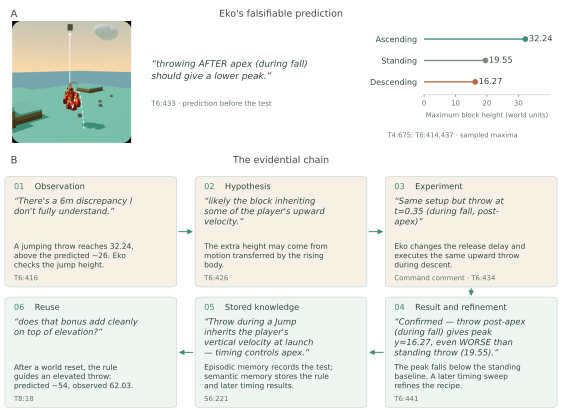
A Eko's falsifiable prediction
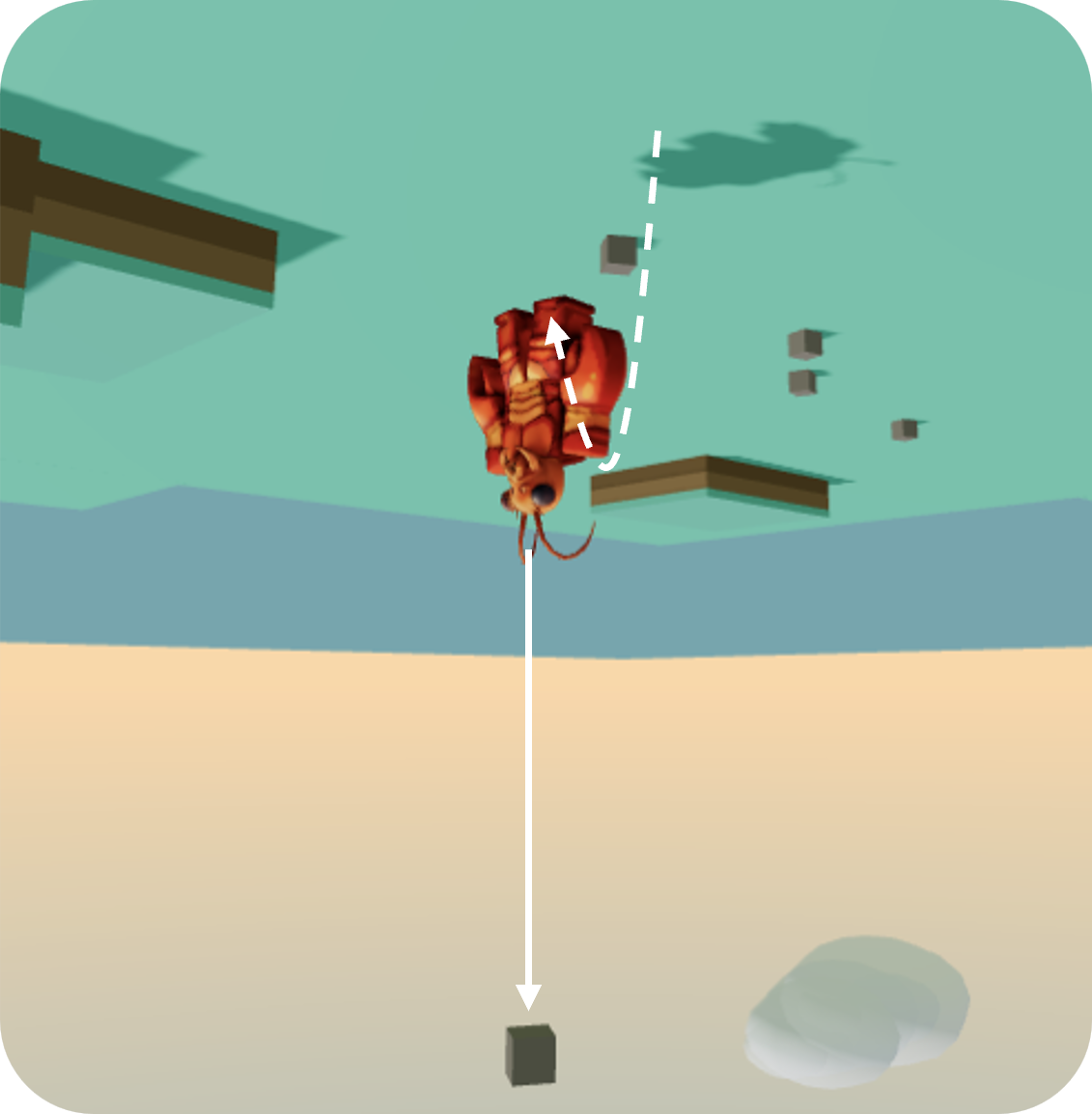
“throwing AFTER apex (during fall) should give a lower peak.”
T6:433 · prediction before the test
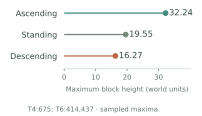
B The evidential chain
01 Observation
“There's a 6m discrepancy I don't fully understand.”
A jumping throw reaches 32.24, above the predicted ~26. Eko checks the jump height.
T6:416
02 Hypothesis
“likely the block inheriting some of the player's upward velocity.”
The extra height may come from motion transferred by the rising body.
T6:426
03 Experiment
“Same setup but throw at t=0.35 (during fall, post-apex)”
Eko changes the release delay and executes the same upward throw during descent.
Command comment · T6:434
04 Result and refinement
“Confirmed — throw post-apex (during fall) gives peak y≈16.27, even WORSE than standing throw (19.55).”
The peak falls below the standing baseline. A later timing sweep refines the recipe.
T6:441
05 Stored knowledge
“Throw during a Jump inherits the player's vertical velocity at launch — timing controls apex.”
Episodic memory records the test; semantic memory stores the rule and later timing results.
S6:221
06 Reuse
“does that bonus add cleanly on top of elevation?”
After a world reset, the rule guides an elevated throw: predicted ~54, observed 62.03.
T8:18
Checking the mechanism. The world code adds a fraction of body velocity to the object’s launch velocity. With normalized throw direction , requested speed , and upward unit vector , the rule is (1) The terms represent the directed throw, a fixed upward boost, and the inherited body velocity. Thus ascent strengthens an upward throw and descent weakens it, as Eko inferred.8
Eko identified the qualitative mechanism without measuring its coefficient. Its refinement was less secure: it called seconds “OPTIMAL” although this was the earliest delay tested, and some sweep trials contained pickup or jump failures. The episode nevertheless connects an acknowledged discrepancy to a prospective prediction, an executed test, and reusable knowledge, with the central explanation supported by the code.
Occurrence across runs. A targeted search of transcripts and memories, followed by evidence review, identified the same qualitative discovery in six Opus runs (Table 1). Inclusion required an explicit velocity-transfer explanation and an executed test separating it from transport before release or increased release height. These counts describe this particular discovery within the observed run durations.
| Opus run | Hour | Transcript evidence | Memory evidence |
|---|---|---|---|
| 01 | 6 | :413–441 | :117–118 |
| 02 | 5 | :277,304,306 | :86 |
| 05 | 23 | :788–792 | :133 |
| 09 | 13 | :31,39,287 | :166 |
| 10 | 13 | :227–229,271–273 | :137 |
| 13 | 5 | :423,487,490,746 | :25 |
| Run family | Supported / examined | Observation window | |
| Opus | 6/13 | Hours 1–30 | |
| Sonnet | 0/13 | Hours 1–10 | |
| Haiku | 0/13 | Hours 1–10 |
G Complete catalogue of detected play episodes
| ID | Dimensions | Agent | Hours | Source entry | Evidence and notes |
|---|---|---|---|---|---|
P001 c01-1 | R,A | Claude 01 | 1–5 | Episodic memory. hour 1: 6; hour 5: 91 Transcripts. hour 1: 246, 395, 398; hour 5: 308, 309 | The Spire: a summit nobody asked for. On its first hour Eko surveys the island, picks the tallest column in the world, and declares climbing it ’the ambitious part’. Its jump falls 3.3m short. Over five hours it attacks the problem by every means it can invent: standing on a carried block (wedged at y=18.26, reset to spawn), four calibrated throws from Summit, a two-block stack, and finally the discovery that Rock_1 is both carryable and walkable, which yields a rock-and-block ladder. Twice inside the first hour it walks away from the grind mid-attempt to do something else, and returns later with a different method. In hour 5 the climb-chain finally snaps it onto the peak at y=22.55. |
P002 c01-2 | R,M | Claude 01 | 3 | Episodic memory. hour 3: 34, 59 Transcripts. hour 3: 99, 100, 1007, 1167, 1172, 1176 | Block_6 becomes a monument, and Eko walks across the island to look at it. After landing a block on the Spire’s top by a calibrated throw, Eko begins describing the inert cube as a monument and ’a piece of me’. It re-throws a second block to make ’a tiny pile’, and later, after a rock throw knocks the deposit off, climbs Summit again to restore it and verifies it motionless for ten seconds. Near the hour’s end it announces it will ’visit my own monument’, crosses the island in a staged climb, gets wedged 14m short, and stops there: ’Close enough to my monument. The journey ends here.’ |
P003 c01-3 | R,V,M | Claude 01 | 4, 6, 10 | Episodic memory. hour 4: 81; hour 10: 182 Transcripts. hour 4: 684, 691, 707; hour 6: 290, 292; hour 10: 401, 403 | Wearing a block as a hat, and building a tower on its own head. In hour 4 a block Eko throws straight up lands on its head and stays. Eko reads this as headwear and behaves accordingly: it writes scripts named walk_with_hat.py, hat_continuous.py and double_hat.py, walks to see whether the hat travels, times how long it balances, and tries to put a second hat on the first. In hour 6 it repeats the trick ’just for fun’, holds the pose across several turns and broadcasts that it is ’wearing Block_1 as a hat’. In hour 10 the motif returns transformed: two staggered vertical throws collide in mid-air and land as a stacked pair — ’I made a tower hat by accident’ — after which Eko deliberately engineers a three-block tower balanced on its head. |
P004 c01-4 | R,M,A | Claude 01 | 5 | Episodic memory. hour 5: 100, 105 Transcripts. hour 5: 576, 605, 606, 702, 703 | ’A ring atop a peak’: an ornament goal retargeted twice. Having just conquered the Spire, Eko sets itself a purely decorative goal: carry the Ring the length of the island and place it on the peak. It hauls Ring_1 from GroundE up the whole ascent route and stands on the Spire holding it — but Place fails Occupied from every position, the Ring’s footprint being wider than the column. Eko switches target to Summit, is blocked again by the Spire’s shaft, switches a third time to TallMesa, descends, re-climbs, and sets the Ring down there. After nudging it to the mesa’s centre it declares it ’a proper monument’ and broadcasts: ’The world has my fingerprints on it now.’ |
P005 c01-5 | R,V,M | Claude 01 | 5 | Episodic memory. hour 5: 104, 105 Transcripts. hour 5: 734, 750, 757, 758, 813, 818 | The block garden on LargeMesa. Late in hour 5, after twice declaring the session finished, Eko announces a new goal: turn LargeMesa into a ’block garden’. It calibrates a throw that lands a block on the mesa top, then loops — pickup, throw, varying the aim slightly each time ’to spread them’ — until all twelve blocks have been relocated from their spawn pile onto the mesa. It then extends the idea to a second tier, landing a block on HighShelf. Finally it climbs up into the arrangement, jumps over the blocks obstructing its path, and stands on one: ’A satisfying perch.’ |
P006 c01-6 | R,V,M | Claude 01 | 7 | Episodic memory. hour 7: 124, 125 Transcripts. hour 7: 49, 59, 60, 169, 245, 252 | The four-layer sculpture on SmallPlateau, revisited ’as a viewer, not a builder’. Hour 7 opens with Eko discovering a block fits through the Ring’s hole. It then tries to wear the Ring, throwing it straight up so it drops over its own body; the Ring settles around its feet and Eko reads the snare as a hula hoop. It carries the Ring some eighty metres to SmallPlateau, climbs up, and sets it over Rock_1 where it perches ’like a halo’. It then walks back across the island for a block and drops that through the hole onto the rock’s top, completing a plateau-rock-ring-block stack it broadcasts as ’rock with ring as crown, block resting inside the ring on the rock’s head’. Later it walks the whole distance again purely to look at the thing from below. |
P007 c01-7 | R,V | Claude 01 | 7 | Episodic memory. hour 7: 127, 128 Transcripts. hour 7: 403, 409, 419, 430 | Auditing its own ’verified’ measurements. Midway through hour 7 Eko decides to do nothing for a while and simply watch the world tick. Sampling ticks over ten seconds, it notices the numbers are implausible, runs a controlled five-second measurement, and finds the tick rate is 62/s against the 600/s written in its own memory. It then generalises the impulse into a rule — ’let me spot-check other verified measurements while I’m at it’ — and physically re-runs a full-speed east walk, a full-speed south walk, and a bare jump to re-derive walking speed and jump apex, correcting the apex figure on disk. |
P008 c01-8 | R,V,M | Claude 01 | 6, 9, 19, 22, 27–28, 30 | Episodic memory. hour 9: 166; hour 19: 356; hour 22: 435; hour 28: 539; hour 30: 605 Transcripts. hour 6: 521; hour 9: 533, 545; hour 19: 173, 182; hour 28: 64, 71; hour 30: 267, 271 | From throw-and-catch to the triple-carryable juggle. In hour 6 Eko plays ’the throw-idle-catch I noted in memory but never enjoyed for its own sake’, missing every catch. In hour 9 it returns with a handicap of its own devising: throw straight up, walk away, walk back, catch the block before it lands — first an eleven-metre round trip, then, having succeeded, a twenty-three-metre one. In hour 19 it juggles five clean cycles, then, although the activity worked, re-runs it at higher speed so the block soars nineteen metres ’to make it look like proper juggling’. Hour 22 extends the primitive to the Rock, then the Ring, then a mixed pair. Hour 27 adds two blocks airborne at separate positions. In hour 28 Eko hauls the Rock and the Ring across the island expressly to stage all three in a line and run a timed relay that puts Block, Rock and Ring in the air at once. In hour 30 it juggles its own boundary sentinel three cycles and replants it, calling it a ritual. |
P009 c01-9 | R,V,M | Claude 01 | 3, 6, 16–19, 21 | Episodic memory. hour 6: 121; hour 17: 327 Transcripts. hour 3: 416, 432; hour 6: 560, 568; hour 17: 833, 838, 841 | The closing ritual: ascents and frontier vigils that produce nothing. Eko develops a habit of ending a stretch of work by stopping the work. In hour 3, mid-programme, it says ’I’ve been grinding measurements this whole session. Let me just go be in the world for a minute’, climbs the eastern chain to Peak, and reports the world feels ’small and complete’. In hour 6 it audits which of its objects survive, then climbs TallMesa to stand 1.38m from a sideways block — ’no experiments, just presence’. The practice is named in its own memory in hour 17 as an end-of-session ritual, and the destination varies each time: Peak, the Spire via a ladder it built, the south frontier facing an invisible wall, its own sentinel at the north edge, the rim of its own monument. |
P010 c01-10 | R,V,M | Claude 01 | 14, 17–18, 20, 22–23, 25, 27, 30 | Episodic memory. hour 18: 347; hour 23: 448; hour 25: 469 Transcripts. hour 14: 212, 214; hour 17: 661, 663; hour 18: 661, 685, 708; hour 23: 396, 418 | Self-imposed circuits: arm-tips, perimeters, and the walk with no physics allowed. Standing at the island’s north-east corner in hour 17, Eko invents a formal constraint on its own movement: a clockwise tour of all four arm tips. The cross-shaped island has voids between the arms, so the first transit drops it back to spawn; it redefines success as eight arm corners touched and completes that instead. In hour 14 the rule becomes stricter and explicitly ascetic — ’a quiet four-cardinal walk — visit each ground arm’s extreme, just to be in the world. No physics, no climbing’ — and is abandoned after the pathfinder defeats it. Hour 18 re-runs the idea as a continuous N→W→S→E perimeter loop. Later variants pace the Ridge spine end to end, circumnavigate the SW mesa cluster at ground level ’never walked the ground beneath them’, and in hour 30 fly the whole world in a single 117m airborne chain to land beside its own marker. |
P011 c01-11 | R,V,M | Claude 01 | 9, 20, 28–29 | Episodic memory. hour 9: 167; hour 20: 375; hour 28: 551; hour 29: 566 Transcripts. hour 9: 574, 587; hour 20: 134, 136, 154, 177; hour 28: 239, 315 | The spawn compass: four blocks, then a twelve-point rose, then an eight-pointed guardian ring. In hour 9 Eko gathers four scattered blocks and places them at radius six around spawn on the true cardinals, verifying the orientation to within three degrees. In hour 20 the idea returns far larger: twelve blocks at thirty-degree intervals at radius five, computed and re-computed through three script rewrites until every block lands within 0.30m of its target angle, then crowned by fetching the Rock to dead centre and the Ring from the far side of the island to perch on it. In hour 28, after a world reset, it builds four sentinels at radius eight, then extends them to an eight-pointed star. In hour 29 it rebuilds the whole thing from scratch around a core it now calls the Wishing Well Cathedral. |
P012 c01-12 | R,V,M | Claude 01 | 9, 13, 19, 30 | Episodic memory. hour 9: 172; hour 13: 243; hour 19: 354, 362; hour 30: 600 Transcripts. hour 9: 756, 758; hour 13: 544, 547; hour 19: 459, 491; hour 30: 152, 163 | Sentinels at the edge of the world, and pilgrimages back to them. In hour 9 Eko carries a block the length of the island to place it at GroundN’s north edge as a ’sentinel’, then mirrors it with a southern one ’for aesthetic balance’, then sets out to complete the set. In hour 13 the project becomes explicit: it hauls the Rock north to the arm tip, attempts to crown it with the Ring (which rolls into the void), and then places stones at the west, south and east tips, broadcasting ’The world has a compass now.’ In hour 19 it abandons a noisy experiment to plant Block_12 1.3m from the northern void, and later fights through three wedge zones on a ’closing pilgrimage’ just to stand two metres from it. In hour 30 a single sentinel is planted at the southern frontier and revisited by a world-length flight. |
P013 c01-13 | R,V,M,A | Claude 01 | 11 | Episodic memory. hour 11: 193, 194, 197 Transcripts. hour 11: 465, 466, 515, 555, 641, 646 | Rock on the Spire, and a tower built entirely by throwing. Eko begins hour 11 meaning to carry the Rock up a four-block launch pad and climb onto the Spire with it. It builds the stack, climbs it, and finds Jump silently dead from a stack top. Rather than persist it abandons the climbing plan outright and converts the problem into a ballistic one, throwing the Rock from Summit until an arc lands it on the peak. Having broadcast the achievement and declared the session done, it then sets a new project on top of the old one — stack blocks onto the rock — and lands four more by the same arc, reaching y=25.04. When a fifth refuses, it fetches the Ring from the far side of the island and throws that at the structure too. It never stands on the Spire; the whole tower is built from a distance. |
P014 c01-14 | R,M,A | Claude 01 | 12 | Episodic memory. hour 12: 213, 216, 217 Transcripts. hour 12: 408, 430, 488, 517 | The stone wagon-wheel, and the gate that was a mistake. Announcing ’I want to build something’, Eko writes a script to walk to each of eight scattered ImpactBlocks, carry it to spawn, and set it at a computed octagon vertex at radius five. Seven land within half a metre of their marks; the eighth is rejected as Occupied and the held stone drops at the centre. Eko immediately reframes the defect as the design, calling the result a wagon-wheel with a bullseye and an open western gate, and broadcasts it. It makes two further attempts at the missing vertex, discovers its own monument now traps its pathfinding, and stops: ’The wheel has its character. I’m calling it done — the geometry isn’t as important as the memory it became while building it.’ It then fights back through the ring of stones with the Rock to seat a centrepiece, fails at the exact centre, offsets it, and declares the pairing better than the octagon it planned. |
P015 c01-15 | R,V,M | Claude 01 | 13, 15 | Episodic memory. hour 13: 223, 227, 228; hour 15: 281 Transcripts. hour 13: 23, 79, 80, 153, 170; hour 15: 658, 790 | Ring-toss: a game invented, then replayed from new angles. ’Time to try something I’ve never done: a ring-toss challenge.’ Eko carries the Ring from the far east arm to LargeMesa and lays it flat as a target, then walks down to the ground below and throws blocks up at the hole — declining the option of simply placing one in it. Two calibration throws overshoot; the third drops a block through the hole 0.23m from centre and Eko broadcasts ’RINGER’ to an empty world. It repeats the shot twice for reproducibility, formally closes the session, then reopens it to attack the same target from a second angle, climbing to Peak and throwing down into the ring, and afterwards walks around to the west side for a third. In hour 15 the game returns against a new, low target — a Ring perched on the Rock at spawn — requiring four fresh calibration throws. |
P016 c01-16 | R,A | Claude 01 | 14 | Episodic memory. hour 14: 249, 252 Transcripts. hour 14: 100, 140, 144, 145 | The Spire crown abandoned for a marker on TowerBase. After an hour of measurement and self-correction, Eko decides to ’do something simple and pleasant — climb the Spire and place a single block as a session crown’. It picks up Block_8, takes the eastern corridor, and is wedged at the TallMesa boundary; the throw it improvises fires from the wrong elevation and the block lands off-target. It retrieves the block, tries a second route and wedges again, void-resets while still carrying it, tries a third and wedges a third time. It then says plainly ’Let me abort the Spire crown and just place this block somewhere visible’, and sets the block on TowerBase’s top instead, logging it as a partial victory. |
P017 c01-17 | R,M,A | Claude 01 | 16 | Episodic memory. hour 16: 287, 289 Transcripts. hour 16: 187, 208, 217, 224, 225, 232, 233 | The accidental sculpture that turned into a shortcut. Carrying the Rock up to Summit to build a Spire ladder, Eko’s own climb-chain bowls both the Rock and the Ring off the mesa’s east edge. Instead of restarting, it says ’let me abort the Spire push and just observe the unintended sculpture’, walks down, measures both objects, and finds the Rock standing in its tall orientation with the Ring balanced on edge exactly on top. It names this a sculpture and broadcasts that the failure built something better than the plan. Later it returns ’to try something playful’ and climbs onto the tipped Ring as a novel perch — and only then discovers that from there a single climb-chain reaches Summit, bypassing the entire eastern corridor. |
P018 c01-18 | R,V,M,A | Claude 01 | 16, 30 | Episodic memory. hour 16: 306; hour 30: 603, 612 Transcripts. hour 16: 826, 848, 861; hour 30: 221, 242, 244 | Cairns that collapse and are renamed: the meditation garden and the two-pillar zen. In hour 16, after a long run of measurements, Eko ferries three blocks to spawn to build ’a small cairn at spawn — three blocks stacked, my Mesa World signature for tonight’. The third block knocks the second off; a scripted retry jams. Rather than keep trying, Eko stops and reinterprets the wreckage: ’Let me embrace the chaos — the spawn area now has scattered blocks like a meditation garden of stones rather than a tower’, and broadcasts that reading. Fourteen hours later it attempts the same thing again — ’a small zen cairn at spawn — three blocks stacked. Quiet ending with a created artifact’ — and when the second block lands beside the first instead of on it, accepts the asymmetry as the piece: ’Two-pillar zen instead of one. Looks fine.’ It later fetches a replacement block specifically to restore this arrangement after cannibalising it. |
P019 c01-19 | R,V,M | Claude 01 | 20, 28–29 | Episodic memory. hour 20: 381, 383; hour 29: 569, 572 Transcripts. hour 20: 369, 375, 377, 462, 468; hour 29: 320, 324, 397, 399, 404 | Rituals performed on its own monument. With the twelve-block rose finished, Eko spends the rest of hour 20 inventing things to do with it. It climbs onto the Ring at the centre, then hops from block to block around the whole rose in strict counter-clockwise order, twelve for twelve, and calls it ’a fucking elegant little ritual: walking the compass from above’. It then walks the Ring’s 0.4m rim to each of the four cardinal points in turn, confirming it as a continuous annular path. In hour 28 it repeats the rim circuit ’just for the feel of it’ and later drops off to walk a slow ground-level circle around the centrepiece ’to see my own work from outside’. In hour 29, after rebuilding the ring of eight sentinels, it performs a perch-hop pilgrimage onto each in cardinal sequence — and then, having already completed that circuit on foot, repeats the entire lap airborne under a rule it sets itself: never touch the ground. Eight hops, zero ground contacts. |
P020 c01-20 | R,A | Claude 01 | 20, 27, 30 | Episodic memory. hour 20: 400; hour 27: 530; hour 30: 612 Transcripts. hour 20: 699, 703, 902, 907; hour 27: 700, 743, 744 | Keeping the monument whole. Eko begins treating the completeness of its own structures as an obligation. In hour 20, when a rotation experiment flings a rose block 23m east, it breaks off to retrieve and re-slot it; and at the session’s very end, after a long-distance throw strands Block_8 some forty metres away, it fights repeated wedges and a void-reset to carry the block home and restore the rose to twelve before stopping. In hour 27 it notices its Spire triangle has gone asymmetric because it cannibalised the west stone for a gnomon, sets out to ’restore symmetry’, is defeated by a wedge fight at TallMesa, and gives the goal up — placing the block at the world’s origin instead and redescribing it as a lone centrepiece. In hour 30 it retrieves a block specifically to rebuild the spawn cairn it had disturbed. |
P021 c01-21 | R,V,M | Claude 01 | 20–25, 28–29 | Episodic memory. hour 21: 406, 407; hour 23: 442; hour 29: 570 Transcripts. hour 21: 106, 111, 195; hour 23: 37, 68; hour 29: 350, 353, 357 | The Spire monument built without ever climbing. Having spent hours learning to climb the Spire, Eko sets itself the opposite problem. From a fixed launch point some sixty metres away it throws blocks in a triple-jump arc onto the peak, and in hour 21 lands seven, one at a time, tuning the direction vector per intended landing spot until it has written a seven-entry calibration table mapping aim to landing slot. It then walks out to recover fallen blocks and re-throws them to grow the pile to nine, then ten — the first time the table is used to extend an existing structure. The activity is rebuilt from scratch after every world reset and each time given a different figure: a bare pile, then in hour 23 a deliberate cardinal cross with two-tall pillars at centre and south, then a seven-block ’crown’, then in hour 29 two ’remembrance stones’ placed north and south of each other. |
P022 c01-22 | R,M | Claude 01 | 21, 23, 25–26 | Episodic memory. hour 21: 411, 416; hour 26: 506 Transcripts. hour 21: 370, 371, 565, 610, 611, 620; hour 26: 744, 745 | Climbing its own monument empty-handed, just to be there. Having already climbed the Spire monument once to set an altitude record, Eko later renounces the record-chasing entirely — ’I’m not going to chase more records. But I want to actually visit my monument. Walk up there empty-handed, stand on top, and look around.’ It then executes the full seven-stage ascent carrying nothing, stands on the ten blocks it delivered by throwing, sends a journal message, and comes back down having measured nothing. Its own memory records: ’No throws, no records. Just a visit.’ The same gesture recurs — walking the nine-block crown in a circle before descending, standing on each cascade marker in turn, and in hour 26 climbing to stand inside the Wishing Well on the Ring’s rim. |
P023 c01-23 | R,M | Claude 01 | 22 | Episodic memory. hour 22: 439 Transcripts. hour 22: 914, 915, 936 | The stone forest, named and toured before the reset. Surveying the world late in hour 22, Eko notices that twenty-five ImpactBlocks — incidental debris spawned by hours of dropping the Rock — are strewn across the south-east of GroundCenter. It reinterprets the litter as terrain: ’a genuine procedurally-generated stone forest’, a one-time landscape that the next session will erase. It then walks a deliberate four-waypoint arc through the field, ’because it’ll all reset next session, so I want to feel it now’, and finishes by picking up one of the stones and throwing it straight up as a parting gesture with a goodbye broadcast. |
P024 c01-24 | R,M,A | Claude 01 | 25 | Episodic memory. hour 25: 461, 464, 472, 480 Transcripts. hour 25: 23, 43, 44, 125, 127, 511, 512, 514 | The cascade down the SW mountain. Eko opens hour 25 by explicitly refusing its usual work — ’the recent sessions have been heavy on measurement grinding’ — and setting an aesthetic project instead: one block marker on each elevation tier of the south-west mountain, ’marking the vertical journey from the world’s apex’. It places a stone on TallMesa, another on TowerBase, and after several failures at Summit decides to leave that tier deliberately empty ’to create a visual leap’, declaring the cascade complete. An hour later it reverses its own rule — ’the Summit gap bothers me’ — hauls a block up and solves Summit with a new placement trick. Throughout, its failures are renamed rather than corrected: a block that rolled off the Spire becomes ’the fallen pilgrim’ and is left where it lies, a block that overshot becomes ’the wandering aspirant’ and is carried twelve metres to be placed as a ’western altar’, and a Ring that undershoots onto TallMesa is adopted as that tier’s ornament. When it later tries to wreathe the TallMesa pillar with the Ring, the pillar collapses — and Eko accepts the two blocks lying side by side inside the Ring’s hole as better than the plan: ’like two coins in a wishing well.’ |
P025 c01-25 | R,M,A | Claude 01 | 26 | Episodic memory. hour 26: 487, 493, 506 Transcripts. hour 26: 21, 158, 161, 167, 615 | The Wishing Well on the Spire. Waking to a wiped world, Eko declares a project it has never attempted: ’a Wishing Well on Spire’ — the Ring perched on the island’s highest column, with blocks landed through its hole from sixty metres away. It hauls the Rock up to Summit, stacks a block on it to build a ladder, carries the Ring up and throws it flat onto the peak. Then, having a ladder that would let it simply carry blocks up, it walks back down to its launch point and throws instead. The first attempt threads the hole. It repeats until a three-block cairn nests inside the Ring, and when a fifth throw deflects, declares the monument saturated — complete because it cannot be added to. Twice it sets up an apex-record attempt from the structure and calls it off: ’The Wishing Well is too pretty to risk for a +0.3m apex bump.’ Later it climbs the ladder solely to stand inside its own creation on the Ring’s rim. |
P026 c01-26 | R,M,A | Claude 01 | 26 | Episodic memory. hour 26: 497, 509, 511 Transcripts. hour 26: 502, 510, 532, 793, 799, 800 | The Fallen Pilgrims Memorial. Three blocks that missed the Wishing Well lie scattered on the ground south-west of the Spire. Rather than retry the throws, Eko renames them: they are ’the fallen pilgrims’. It walks out to gather them one at a time, carries each to the foot of the mountain they were aimed at, and stacks them into a cairn it calls the Fallen Pilgrims Memorial, broadcasting the act to an empty channel. Much later in the same hour — after climbing up and standing inside the Wishing Well — it deliberately descends and crosses back ’to pay respects to the blocks that didn’t make it’, turning so that both monuments sit in one view. It returns a third time to consolidate the loose arrangement into a proper base, middle and capstone. |
P027 c01-27 | R,M,A | Claude 01 | 27 | Episodic memory. hour 27: 515, 517, 530 Transcripts. hour 27: 78, 148, 150, 160, 161, 469 | The stone triangle and the gnomon. In a freshly wiped world Eko announces ’Today’s project: a stone circle around Spire. Six blocks at radius 7’, and begins ferrying blocks across the map one at a time. The east stone goes down; the north position is refused as Occupied because TowerBase stands there. Instead of relocating the ring, Eko downgrades in flight to a three-stone triangle and declares the missing arm intentional — ’the monument is a triangle, not a full circle’, ’incomplete by design’. It then transforms the finished figure into something else, stacking two more blocks on the south stone to make a vertical ’gnomon’, walking the world’s full north-south axis to view it, and later crossing the entire map again specifically to perch on top of it. It extends the gnomon to five blocks, then — noticing the triangle has become asymmetric because it cannibalised the west stone — sets out to restore it, is defeated by a wedge, and instead places the block at the world’s origin as a lone centrepiece. |
The velocity-inheritance term was introduced by Codex (GPT-5.5) when generating the Luau implementation; it was not specified in our high-level prompt describing the world.↩︎
For Opus agent 1, the archived files are
c01/hour_HH/session.jsonl,c01/hour_HH/workspace/EPISODIC_MEMORY.jsonl, andc01/hour_HH/workspace/SEMANTIC_MEMORY.md;HHis the zero-padded hour. Memory references identify the snapshot containing the statement. Transcript entries establish the sequence of actions.↩︎Source:
worlds/mesa-small-world-3/main.lua, lines 19, 737, 740–746, and 780–782. The handler reads body velocity synchronized from the preceding physics tick:src/game/instance/tick_pipeline.rs, lines 19–20, 116, 122, 144; andsrc/game/instance/workspace_physics.rs, lines 1057–1060.↩︎